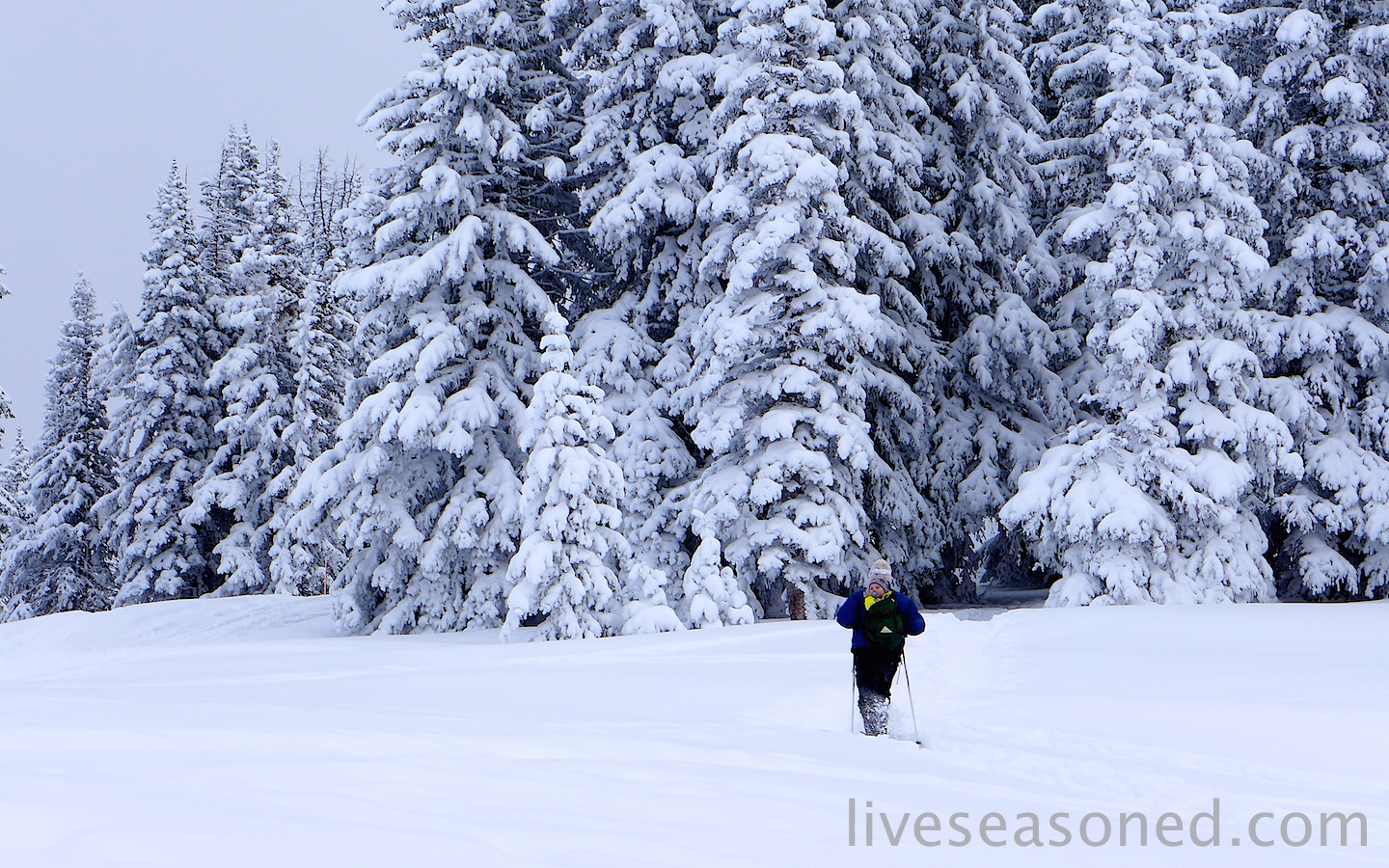
Snowshoeing in the Rockies II

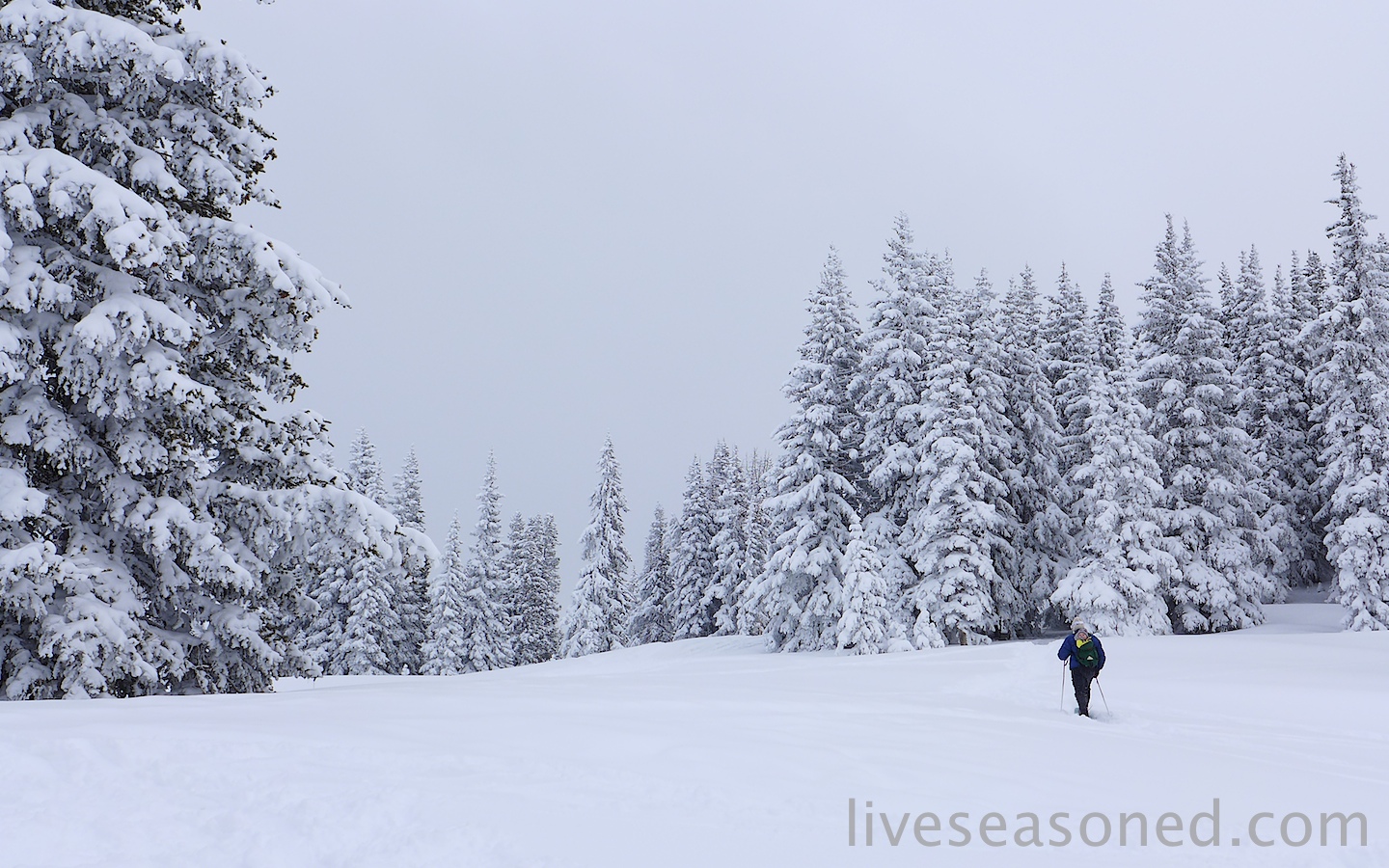
This is Alex’s second winter and the second year that we took the little guy out on a snowshoeing adventure during our Christmas break. If you like to get outside for exercise and have a little one that’s too small for many winter sports but is happy to be bundled up and spend a bit of time out in the cold, then this is a great family winter activity!

pops2

In our case, Alex is still too little to ski and pregnancy is limiting my options this year, but snowshoeing is the one outdoor activity that we can all do (other than our many, many walks around the neighborhood pulling the little guy in his sled!).

Planning for an afternoon snowshoeing adventure is relatively simple:

  • Special equipment. You’ll obviously need a pair of snowshoes. A good pair can be a bit expensive, but will provide years of entertainment if you like going out. On the other hand, there are only a few sizes of snowshoe, based upon the wearer’s weight, so why not borrow or rent a pair before buying your own?
  • Got your gators? If the snow’s particularly deep and fluffy, then you may want to wear a pair of gators. On this trip, Calder’s wearing gators, while I have a pair of tall boots; both work well.
  • We suggest dressing in layers ~ it may be cold outside, but it’s likely that you’ll quickly build up some body heat with each step, so you’ll want to be prepared to unzip and possibly take off your outer layer.
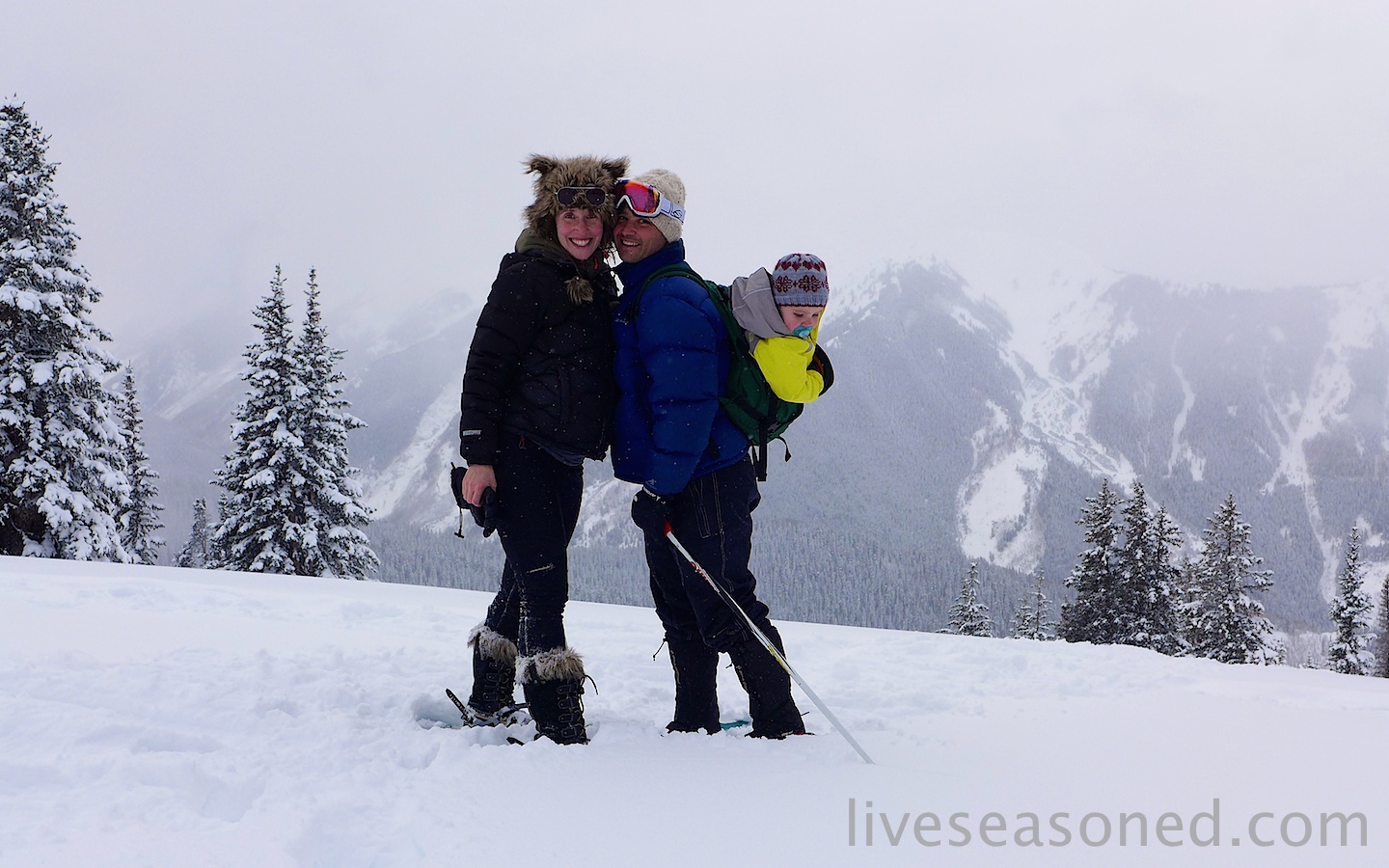
  • Plan on carrying little ones. As you can see, last year we were a bit more prepared for the adventure, using a proper baby carrier. This year, we forgot all carriers in our packing frenzy (rushing to get on the road before a Christmas day winter storm). BUT we had this regular old backpack, and, much to my surprise, Alex was more than happy to sit in it for the whole trip.
  • Don’t forget your sunscreen.
  • Tell someone where you’re going.

family2

It was a cold day, so we only stayed out for about 20-30 minutes, but that was plenty of time for a good walk. *** Quick note ~ this is where we should mention that if you’re pregnant you may want to proceed at your own risk (or, talk to your favorite doc first). While Calder and Alex went on a larger loop, I realized that at such a high altitude it was better for me to take it slow and walk with them at the beginning and end of their loop rather than push my limits. If you exercise regularly, a vigorous snowshoe at lower altitudes while pregnant is much less of an issue.

gondola

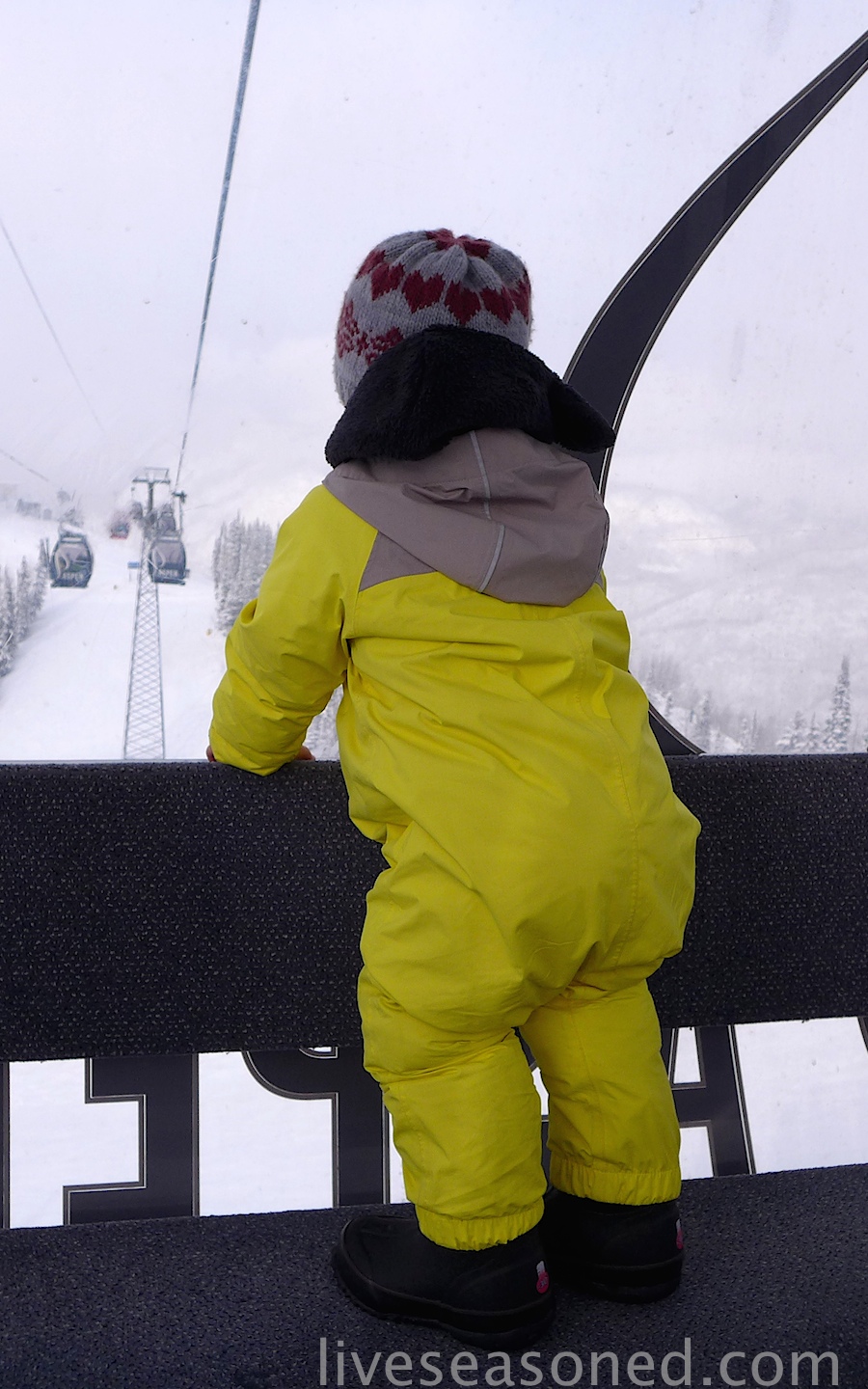
This turned out to be one of those perfectly planned days where we were able to meet everyone’s fun quota.  We rode the gondola to the top of the mountain, which makes the whole adventure even more fun for little ones! Calder carried along his skis and was able to put in a few runs after our walk while Alex and I warmed up by the lodge’s fir. Then we all had lunch before Alex and I rode the Gondola down and Calder took another run to the bottom of the mountain.

At that was it ~ our simple but fun snowshoeing adventure for the whole, growing family… we’re hoping to fit in a few more trips this winter, and I’m already imagining next year’s adventure when we’ll have two little ones in packs! 
pops

German Christmas Markets

liveseasoned_winter14_germany-7-2

In October, we revisited our adventures in Thailand.  We thought we should give you a glimpse of what we were up to a few Decembers past.  In 2010 Katie and I went to visit Calder, her fiancé (they’re married now), who was living and working in Germany.  Our trip was amazing and I think it had to do with a few key factors: Katie, C and I all get along really well, C is fluent in German (hellllllo helpful!) and we kept the trip spontaneous and largely unplanned.  Mix great buddies with little stress and lots of snow and you have a Christmas adventure that will never be forgotten.  Oh and breakfast!  Almost every hotel offered a complimentary breakfast, which consisted of a big deli platter with lots of yummy meats, cheeses and the best baked bread.  You are also offered eggs, cereal, yogurts and fruit.  We started each day with coffees and cheese, please tell me how we could have possibly had a bad time? I actually had such a blast that I completely forgot to e-mail a final paper to a professor during the trip! Yep, I wrote a ten page research paper and forgot to turn it in that’s how awesome our Christmas trip to Germany was.

Now when I think of Christmas traditions, I actually think of the German Christkindlmarkt.  I feel like visiting the markets is the most historic lens I’ve ever looked through when it comes to the holiday season. The markets are held in the center of villages, towns and cities.  The backdrop and surroundings of each market is historic and stunning in itself.  Every Christkindlmarkt has a variety of gifts and holiday goodies.  The markets are a glimpse of the past; you won’t find tacky Christmas commercialization here.  Over the course of a week, we visited five markets ranging from enormous to quaint. Each market had crib figurines, ornaments, toys, wood carvings, decorations, candles, furs and a variety of other crafts and goods.  The markets also had the most amazing food.  It kicked any American fair food’s behind.  We usually ate some type of bratwurst and sauerkraut on a fresh, crusty roll. We kept warm by sipping glühwein and sampling dozens of treats throughout the day.  Each city’s market had a slightly different vibe and while I loved visiting every one, Esslingen’s medieval market may have been my favorite.  Read on to see why…

Continue reading

Ingredient of the Season : Oranges

Every season we like to pick one ingredient and find a variety of ways to love it and use it. You can find our complete ingredient archive here.

We’re decided that the orange, that zesty winter fruit, was the perfect choice as our ingredient of the season. As with past seasons, you can expect a slew of orange posts. The fruit will be a highlighted ingredient in our baking and candy making. We’ll use them around the house. And, of course, we have a few orange crafts up our sleeves; in fact, if you want to get a head start, you could make some dried orange garland!

We grew up ordering cases of oranges from our high school band’s fundraiser that would arrive around this time every year. As a result, we have fond memories of making our mom’s orangeade recipe (that she got from her mom), and it gave us our first education into the wide variety of oranges (note – use the hamlins for juicing, not the navels!). Having piles of oranges around the house at this time of year is such a tradition for us that we can’t think of a better ingredient to brighten our senses and the long, dark winter than oranges, and we’re excited to kick things off with a little profile of the fruit.

History

There are no known oranges growing naturally in the wild. It is believed that the species originated somewhere in Asia, possibly China or India, and that they were first cultivated in China in 2500BC. The sweet orange was not known in Europe until the 14 or 15 hundreds, having been brought to the Mediterranean region by Italian and Portuguese merchants. The orange then made its way to the Western Hemisphere with Spanish explorers in the late 1400s, and had spread across the US from California to Florida by the 1800s.

The word orange derives from a Sanskrit word for the fruit, nāraṅga. In English, and many other languages, the beginning “n” was dropped, and it is believed this happened when the word was translated into French, where the n may have sounded like it was part of the indefinite article preceding the word. For example, une norenge would have been the correct spelling, but would have sounded similar to une orenge. And you may have already guessed this by now, but the color orange was named after the fruit (something I’ve wondered when looking through my crayola 64 pack!).

Biology

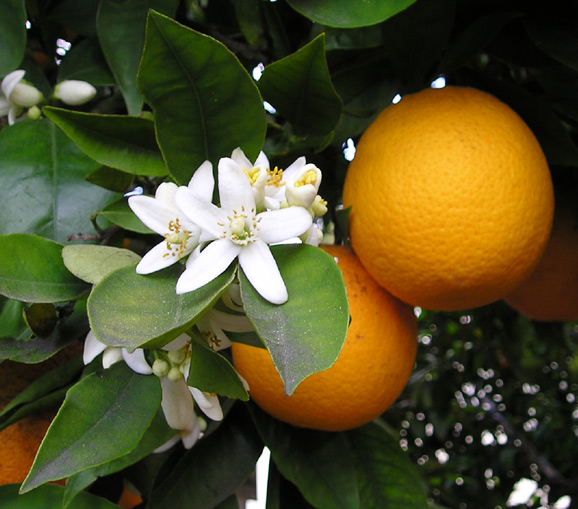
Orange typically refers to the sweet orange, not bitter oranges or mandarins. The orange tree is an evergreen, flowering tree that grows primarily in the warmer climates of the tropics and subtropics, requiring a lot of sunshine and water to thrive.

OrangeBloss_wb

One interesting fact about all citrus trees (oranges, grapefruits, lemons, limes, etc.) is that they appear to be interfertile, this means that they can interbreed, producing many hybrids. Due to this interfertility, it is difficult to keep track of the historical breedings that produced many of the varieties of oranges that are available today. It is believed that oranges are a hybrid between pomelos and mandarins. Since oranges are a hybrid, there are challenges to breeding the fruit. If you grew a plant from seed, it may be infertile or produce a fruit that is different from its parent plant. As a result, most propagation is done through grafting, creating clones of the parent tree.

Since the fruit often produces multiple seeds, is fleshy and soft, and derives from a single ovary, it is actually considered a modified berry! The fruit only ripen while on the tree (as opposed to avocados and bananas), but it is not unusual for the orange rind to remain partially green even on fully-ripe fruit. Recognizing that a green rind is unappealing to many consumers, ethylene gas, a common plant hormone, is often used to turn the rind of commercial fruit orange before they are sold. And knowing that the fruit will not ripen off the tree, there are laws in California, Florida, Arizona, and Texas that forbid the picking of unripe citrus for human consumption!

Varieties

There are many varieties of oranges, but some of the most common (at least in the States) are:

  • Hamlin : A small, light-colored, juicy orange that’s perfect for juicing because it’s seedless. In season from October through December.
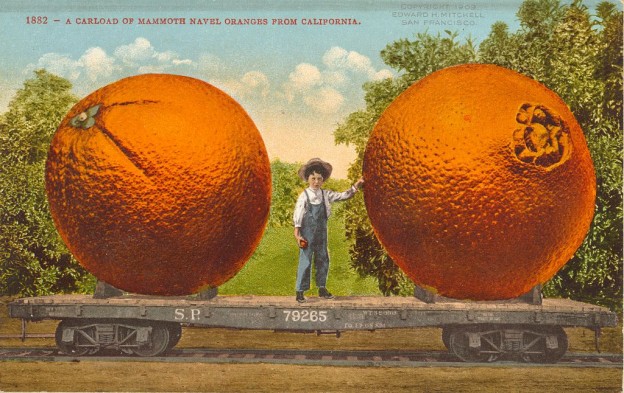
  • Navel : A very popular variety. They are easy to recognize because a second fruit will start to grow at one end of the orange, creating a belly-button-like bump (similar to our navel, get it?). They are less juicy than other varieties, but having a thick skin that is easy to peel, making them a great snacking orange. In season from November through April.
  • Valencia : Excellent for eating and juicing. A late season variety that ripens from March through June, making it a popular variety when most other orange trees are not in season.
  • Blood Oranges : A natural mutation gives these oranges their red color, which comes from the production of class of pigments call anthocyanin. They were first discovered in Italy, but are now grown world-wide.

CarloadMamothNavelOranges-624x393

Do you have any favorite orange recipes, crafts, or uses? Fond memories of knowing that there would be an orange at the bottom of your stocking every Christmas? Or hoping to start a new tradition of Christmas morning mimosas? Let us know, we would love to hear!

Orange tree with blossom image from here. Orange color square from here. Indian River label from here. Indian River bushel graphic from here. Blood orange image from here. Navel orange from here.  Black and white orange picker and boy from the LOC.


Best of the Season

At the end of each season, we take a look back and highlight our favorite posts. See previous Seasonal Bests here.

I don’t know about you, but for me fall seemed to creep along during September and October, and then November passed in a flash! I can’t believe that Monday will be December. I can’t put my finger on exactly what’s making it seem different this year, it probably most definitely has something to do with Little A being old enough to start enjoying the magic. Anyway, while we’re excited to jump into winter with both feet, we also love taking a moment to look back and relish all things fall.

Best of Main Dishes

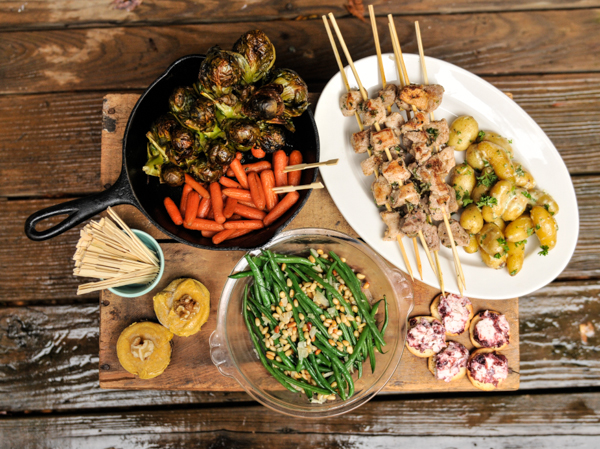
liveseasoned_fall14_thanksgivingtapas-7

  • Sarah’s pick : I’m a big fan of Katie’s Roasted Root & Squash Soup for three reasons.  First, it is a dish that spans two seasons and can easily be modified to include whatever roots and squash you have on hand.  Second, it is packed with veggies and can be vegan if you leave out the cheese garnish.  Third, it is a great recipe for a beginner cook.  No tricky steps or hard to find ingredients in this dish.
  • Katie’s pick : Sarah’s Thanksgiving Inspired Tapas! Every time I look at that post, I wish I were a guest at the table. It’s a perfect twist on the traditional Thanksgiving dinner and looks delicious. And I have to admit that I usually shy away from tapas restaurants because I assume that I’m going to leave hungry, so I really like the idea of serving tapas at home, and know that I won’t be craving more because the leftovers are in the fridge.

Best of Desserts

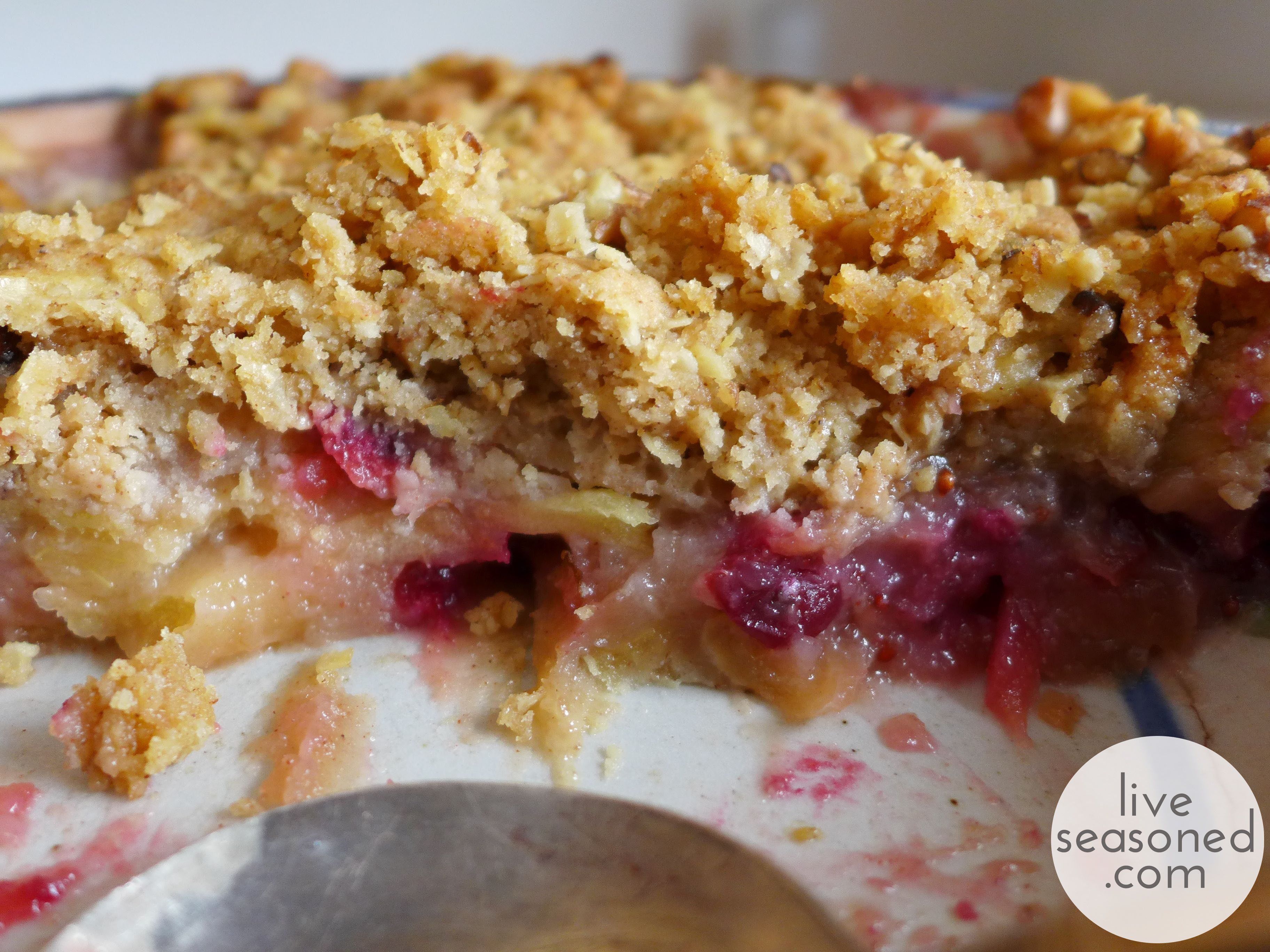
liveseasoned_fall2014_applecrisp2_wm

  • Sarah’s pick : I’m in love with the mini no bake pumpkin pies.  They’re creamy and chewy and they are packed with protein.  I’m not going to pretend that I always eat healthy desserts, but these pumpkin pies are my new favorites.
  • Katie’s pick : I’ll take a good apple crisp any day, especially one with cranberries! And yes, I’m totally cheating, because this should be in the “Best of Breakfasts” category for me.

Best of Alcoholic Drinks

liveseasoned_fall2014_sidecar3_wm

  • Sarah’s pick : Katie served me my first Apple Sidecar and I remember taking a nap immediately afterwards.  This time I took her advice and added a big chunk of ice to my drink. Delicious and festive, this apple sidecar deserves a spot on your holiday cocktail menu.
  • Katie’s pick : It’s been a long time since I had an Appletini, but Sarah’s post took me right back to a bar in Philly where we would get cheap appletinis at happy hour. I’m sure they have nothing on Sarah’s well-garnished drink. I’ll just add it to the growing list of post-baby drinks!

Best of Non-Alcoholic Drinks

liveseasoned_fall2014_thanksgivingmocktails5_wm

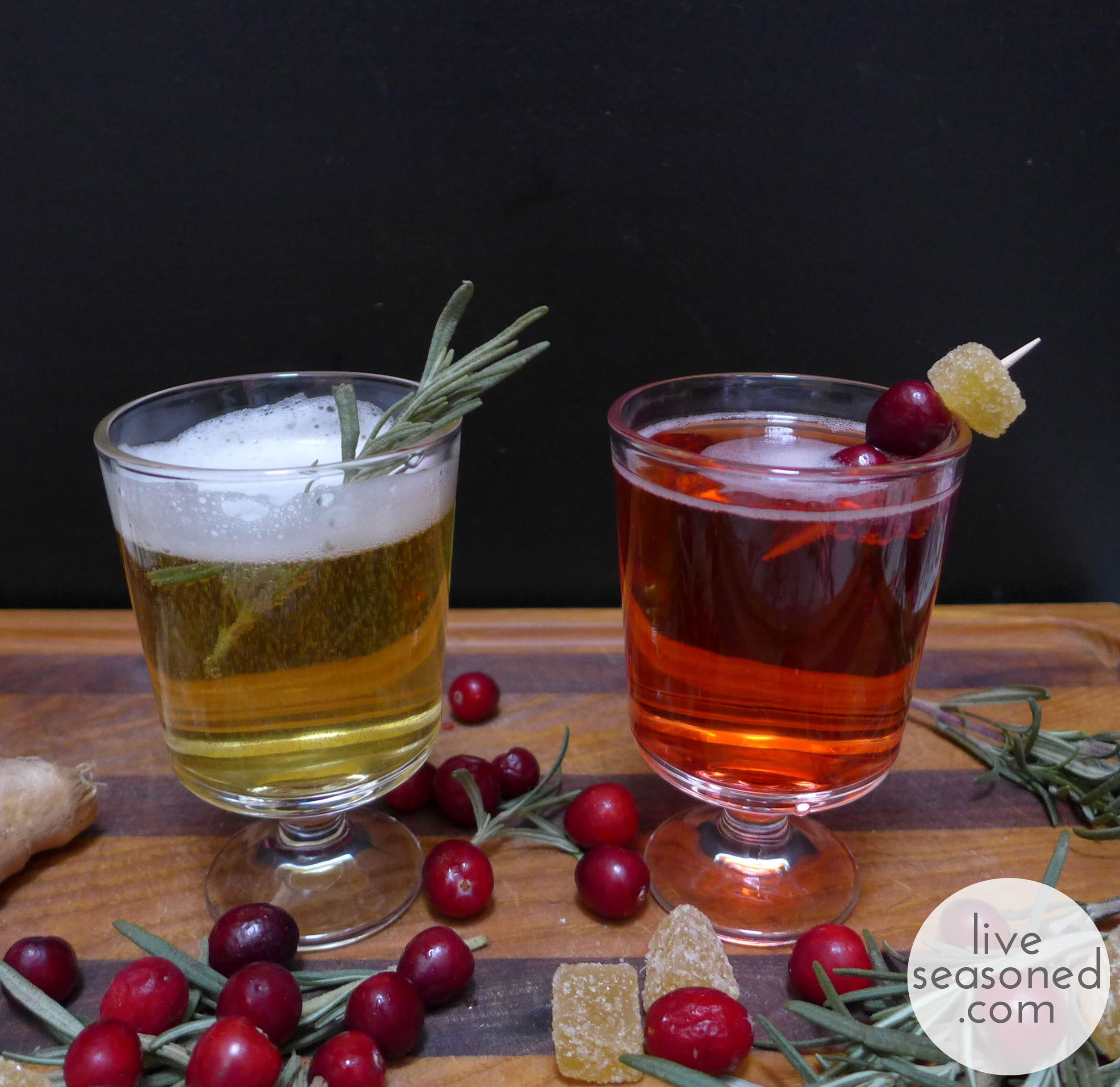
  • Sarah’s pick : There was no contest here, Kate’s Sparkling Cider Mocktails are by far the best non-alcoholic drink of the season.  I wish I had a little crew of kids to serve up these special drinks to.  I know they would really appreciate them.  I always loved Shirley Temples growing up, but they’re no comparison to these special sparkling holiday mocktails. Without any kiddos around, I make these mocktails during the middle of the day as motivation to keep editing and accomplishing menial tasks around the house.
  • Katie’s pick : I’m eyeing Sarah’s Fresh Apple, Carrot, Ginger Juice. That sweet and spicy combination, just seems so perfectly refreshing at any time of year, but especially have a good fall hike… and really, really miss when Sarah and her juicer lived with us!

Best of Cheese

LIVESEASONED_fall14_brie2

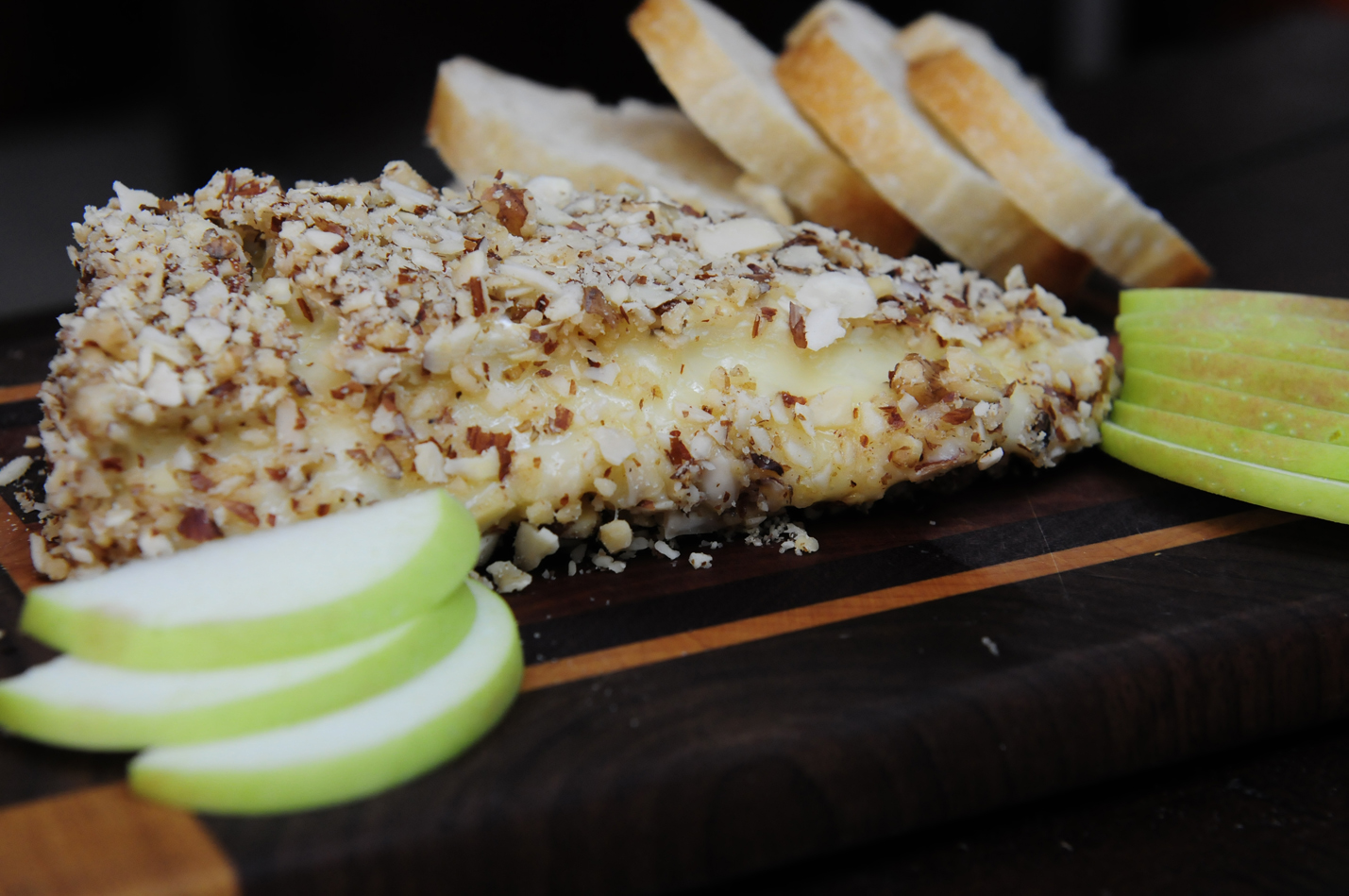
  • Sarah’s pick : My favorite was the first cheese we featured, Nut Crusted Brie. I love the gooey baked cheese along with the crunch of the nuts.
  • Katie’s pick : Brie with Truffle Honey. I want to eat it every day.

Best of Crafts

  • Sarah’s pick : I loved looking back at the craft category and seeing how many natural crafts we made this fall.  I enjoyed making the leaf garland and outdoor twig wreath, but my favorite has to be Kate’s dried fruit garland.  I just love the look of sliced oranges and apples, if you haven’t made it yet, turn on that oven!
  • Katie’s pick : I had as much fun making the witch window silhouette as I did seeing it every night in our window. I also think it’s a project that was worth the time and effort, because we should be able to reuse it for years to come.

Best of Style

LIVESEASONED_fall14_favorites

  • Sarah’s pick : We don’t do many fashion features on Seasoned, but I do give glimpses of my daily threads.  I’m loving these dressed yet comfortable pixie pants that I picked up at Old Navy.
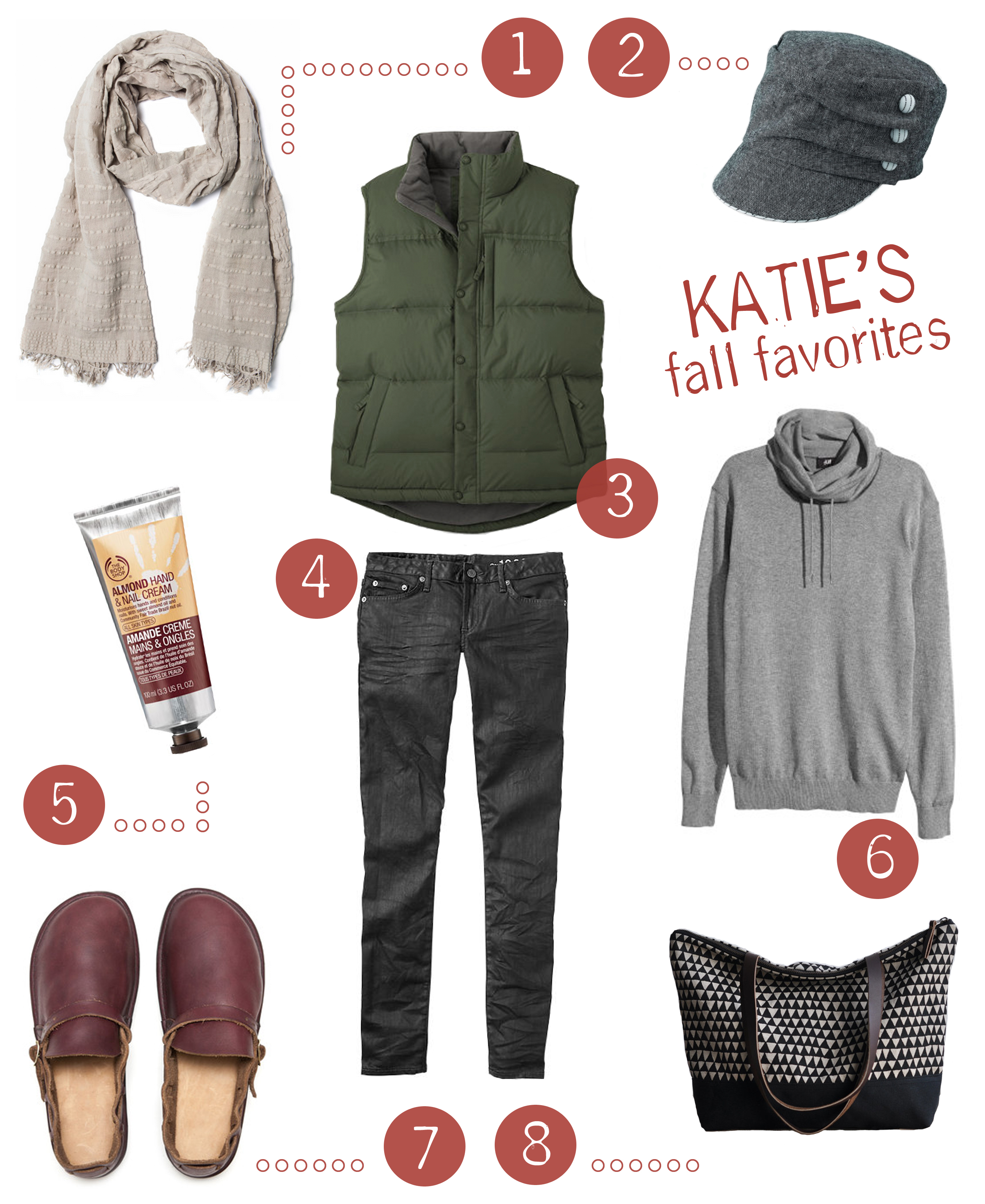
  • Katie’s pick : Admittedly most days you’ll find me in yoga pants, but when I do get dressed to leave the house, I’m wearing some version of my Fall Favorites. So maybe I’m picking it not necessarily because it’s the best style, but because it’s my perfect fall wardrobe, and it never gets old.

Best of Potions

  • Sarah’s pick : Even though this potion was a tiny bit smelly, I enjoyed making my own pore strips.  Super duper cheap and really easy too.
  • Katie’s pick : I’m going with the Dandruff Shampoo because it was so stinking easy to make, and it worked!

Best of Nature

liveseasoned_fall14_autumn-2

  • Sarah’s pick : Can I cheat and mention two posts? First, I loved researching and writing about the Boulder Flat Irons Hike almost as much as I enjoyed the trek itself.  It is so much easier to take photos and really enjoy the landscape when you don’t have a crazy hound dog along for the walk. Second, I had a great time making the photograph and turning it into a quote celebrating the Autumnal Equinox.  Celebrating natural holidays is very important to me so spending time outside this year and creating this image was my way of thanking the earth.
  • Katie’s pick : I found Sarah’s Tips for Taking Fantastic Fall Photos to be so helpful. It’s not specifically a nature post, but it’s the type of post that inspires me to get out there and enjoy nature a bit more, even if it is through the lens of my camera.

Best of Around Town

liveseasoned_fall14_kombucha-8

  • Sarah’s pick : While this better suits the category Best of Around the World, I had a great time revisiting Thailand for this Bangkok City Guide.
  • Katie’s pick : I loved our visit to the local Kombucha brewer. Getting the chance to taste-test so many flavors at once was a great exploratory mission. I now know that I love so many flavors beyond my old stand-by. And it was awesome to discover this Boulder gem with Sarah.

Any favorite posts that you didn’t see on the list? Let us know in the comments 🙂


Katie’s Pregnancy Favorites

If all goes well, we’ll be adding another little guy to the fam this spring! Of course we’re super excited, and we thought it would be fun to do a series of posts on pregnancy and baby-related products and tips that worked for me. Maybe they’ll work for you too?

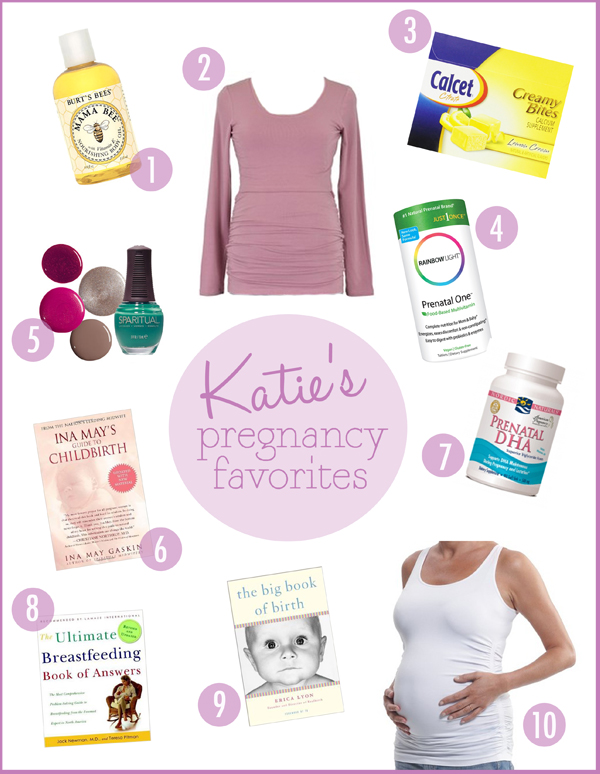
First up, I wanted to share some of the products or tricks that I found useful while pregnant with A. Max, and that have proved helpful this time around too. I’ve made it a point of trying to be low maintenance when it comes to pregnancy and baby-related items, but even with a minimalist attitude, there are still some things that are worth the purchase. Below are my essentials along with some of the tips & tricks that made it easier to buy less maternity-specific stuff. To go to the product pages, you can click the numbered links below each collage or the links provided within the post’s text.
liveseasoned_fall14_pregnancy copy

1/2/3/4/5/6/7/8/9/10

Prenatal vitamins.

Ugg. I hate taking them every day, but am serious about doing it before, during, and after a pregnancy. Luckily I’ve found the brands that work well for me and minimize some of the negatives associated with other vitamins. I really like this multivitamin. It doesn’t have as strong as a smell as other vitamins, I never get an upset stomach with it, and generally felt healthy (although I never took another vitamin, so I don’t have a good counter example there). I also took a DHA supplement. DHA is one of the omega-3 fatty acids that’s important for brain development. Taking a prenatal DHA supplement is helpful because you won’t get as high of a dose of DHA if you take a basic omega-3 supplement. Also, while this supplement is made from fish oil, I’ve never had any issues with a fishy smell or aftertaste. I didn’t take a calcium supplement with Alex – I just tried to get plenty through my diet, but this time around I found Calcet’s lemon creamy bites, and no I’m hooked! I use them as a healthy treat when I need just a little something sweet, and I like them so much more than the other calcium chews that I took years ago but got tired of. The only thing I don’t like about these is that each chew is individually wrapped in a plastic shell – not that great for the environment, but it seems to be the key to their fresh, creamy texture. So I’ll probably be done with these after this pregnancy or this box… but I had to mention them, because if you need a calcium supplement, these are outstanding.

Clothes

When it comes to clothes, I’m fortunate in a number of ways. First, I’m pregnant during the exact same time of year, so I’m able to use all of those maternity clothes again.  Second, I mainly work from home, and while last time I had to go in to a job, I really only saw people a couple of days a week. So, many days yoga pants and long stretchy t-shirts or tanks were enough to cover my belly and keep me comfortable. I found that many of the dresses I already owned (I love ones from Title Nine with a touch of spandex, like this) were stretchy enough to fit over my growing belly for at least the first 6-7 months of my pregnancy. I was also lucky that sweater dresses came back into fashion – so I picked up a few of the boxier ones, some tights, and my favorite boots to get me through the rest of my pregnancy – this was an especially great outfit for days I had to teach.  Once my stomach got too large for my pre-pregnancy pants, I bought four pair of maternity pants and a few shirts to go with them – that’s it!

But, even so, there are a couple of specific items that are worth sharing. This maternity tank from Target is so comfortable, and I love how long it is. Late in pregnancy, it was hard for long non-maternity tanks to stretch around my stomach, but this tank does without trouble. I still have the only one I bought, and am thinking it’s time to add a second one to my closet – they are a perfect first layer under any shirt.

As I mentioned, I bought a few maternity shirts, mainly for work days to go with the pants I picked up. I didn’t know it at the time, but there are whole lines of nursing shirts with ruched fabric around the torso – making them perfect for a growing stomach during pregnancy and a slowly shrinking one afterwards. Buy these, especially if you want to try nursing, rather than buying a maternity-only shirt (I found that the BOOB brand really held up well to the wear and tear that is nursing and carrying a little guy).

Books & Other Info

We are just over halfway through this pregnancy, and it was around this time with Little A that I was ready to start learning about labor, labor support, and breastfeeding. Along with taking a labor class, there were a few books that I found really useful.

  • The Big Book of Birth – this book is packed with useful information, so at times it can seem a bit dense, but I really loved the straightforward and concise writing. She covers basic biology of labor as well as types of medical interventions and natural methods for easing discomfort and dealing with different problems that may arise during birth. Calder didn’t read the whole book, but I marked some sections that I thought would be particularly useful for him to read before our delivery, and I think it was helpful to both of us.
  • Ina May’s Guide to Childbirth – This book focuses more on natural childbirth and methods for finding comfort and support through it. I have to admit that I didn’t read this one cover to cover like I did the Big Book of Birth, but I did find it extremely useful, and Ina May’s an expert if ever there was one.
  • The Ultimate Breastfeeding Book of Answers – Before I had Alex, it seems like I often heard about how hard or tricky breastfeeding could be, but I knew I wanted to do it. Knowing that I didn’t want to find myself with a newborn in my hands and unsure of what to do next, I decided to read and learn about the process before having the baby. I found both Jack Newman’s book and his website to be extremely helpful for covering the basics of breastfeeding and providing many useful images and videos of successful and unsuccessful breastfeeding – so I was able to get a sense of what I should look for and red flags for when things weren’t working.

In addition to these books, Calder and I took a seven-week prenatal and labor class together. Our class covered everything from the baby’s development in utero, to the biology of labor, support for labor, types of medical interventions, caring for a newborn, etc. It was so amazing, and really helps you to work through all of that material, especially when you’re working and are so tired that you would rather crash on the couch than read a book. We had the option of taking that class or shortened version of the class over the course of a weekend. I highly recommend spreading your course out over a few weeks – there’s so much information to learn, and you may find that questions develop only after you’ve had days/weeks to think about something from class – there’s no way you and your labor partner would get as much out of a weekend course (but, if that’s all you have time for, it’s better than nothing!).

General Beauty Products

In general, I use very few beauty products, but when I do, I try to stay as chemical-free as possible. One place where that’s hard to do is with nail polish. I would skip it altogether (and that’s what I did with my first pregnancy), but this time around, my nails are really suffering from the dry air. When they are dry, they crack, peel, and just become a general mess. A coat of polish along with daily applications of cuticle oil really helps to keep them healthy. So, this time around I tried Spa Ritual’s 5-free polishes, and really (really) love them. I use them with a base and top coat, and have found that they can go at least 5 days without chipping (less if I’m really doing a lot of mess work with my hands).

Another product that I’ve been devoted to throughout both pregnancies is Burt’s Bees Momma Bee Body Oil. I slather it on my belly after every shower throughout the whole pregnancy and for a few weeks postpartum (about 3 times per week). I was really lucky to end up with no stretch marks last time around. We’ll see what happens this time!
liveseasoned_fall14_stayinghealthycollage copy

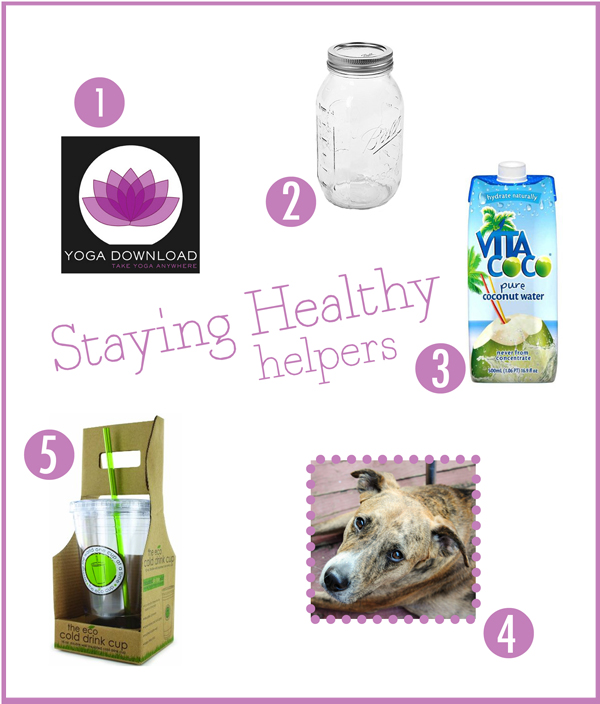
1/2/3/4/5

Staying Healthy

When you’re pregnant, you hear over and over again that it’s important to get plenty of exercise and stay hydrated. Staying hydrated is even more important for me this time around since we’re in a dryer climate.

Honestly, after months of drinking water, tea, and chocolate milk, I start to go crazy for anything else to drink (we’re not big juice drinkers, just as a rare treat). I found a few tricks to help me stay hydrated. I’ll treat myself to cartons of coconut water – you get an electrolyte bonus! Trader Joes’ brand is always a good price, but I’ll take any brand that’s on sale. I also mix up my drinking vessels. The first time around I picked up one of those cold cups with a straw, and found that just switching between my drink bottle and that would have me drinking more. I also found the cup easier to drink out of while breastfeeding and rocking a newborn (rather than having to tilt my head back to use the drink bottle).

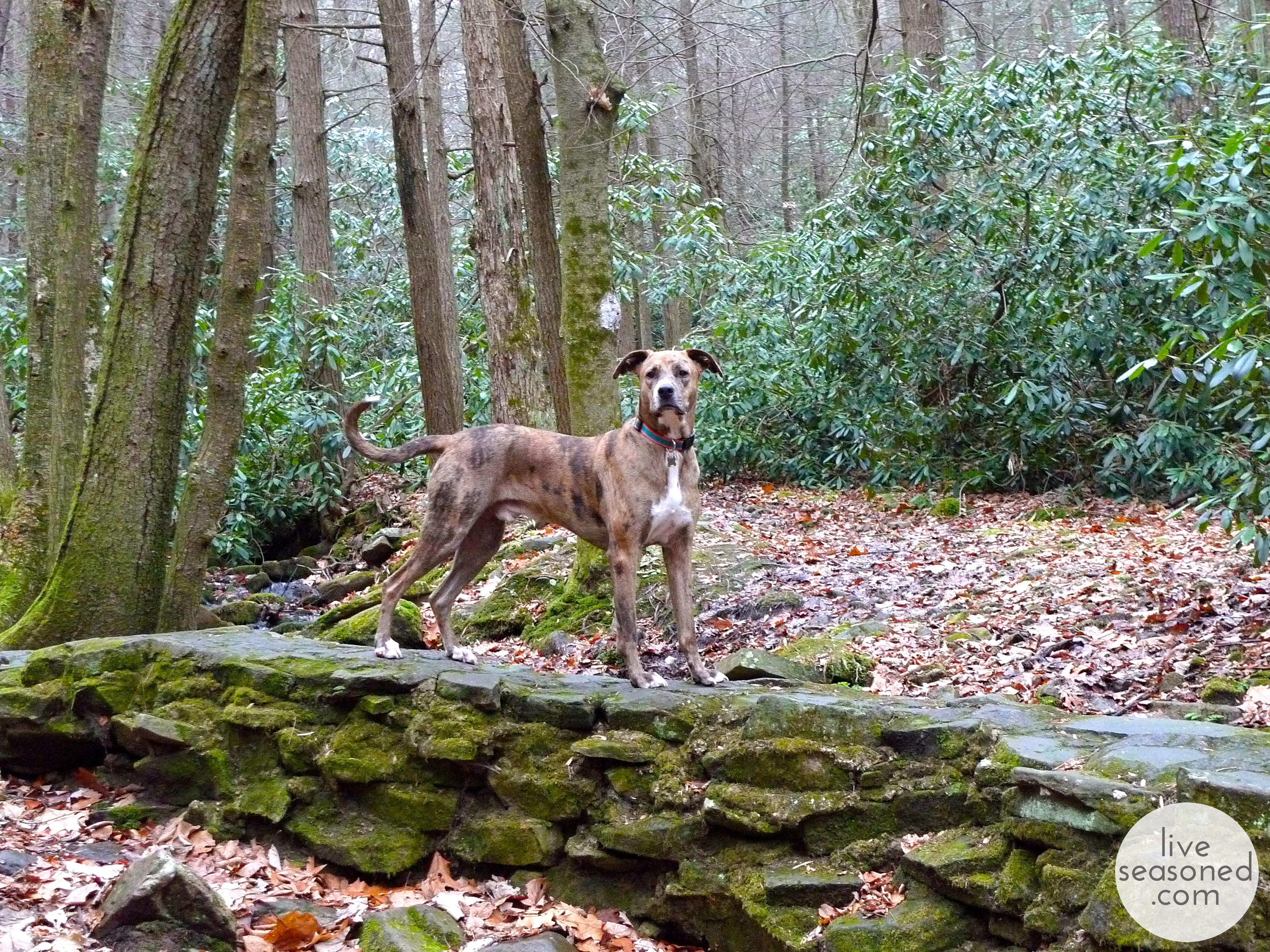
When it comes to exercise, having Ca$h the dog was such a big motivator. When he’s with us, I’m his main walking companion – so that meant that I went out on long (30 minutes to an hour+) walks with him twice a day. I did that all the way until the end of my first pregnancy and I know that it really helped me to stay in shape and stay a healthy weight. This time around we don’t have the pooch with us (he’s with Sarah!), but I’m making sure to get plenty of play time in with Alex, and it seems to be working :-).

In addition to the dog walks and Alex adventures, I liked to take some time to do some good, deep, yoga stretching. I tried out a few prenatal yoga classes, and they were great, but I also found it really hard to fit them into my schedule. After a bit of searching, I came across Yoga Download and was an immediate fan. There are a number of ways to access their classes, but I purchased a couple of prenatal yoga classes and downloaded them onto my laptop. It was nice to have access to them at any time and without having to worry about an internet connection. I’ve since purchases some regular (not prenatal) classes and have used them whenever I need a yoga boost – while I would love to go to a studio, practicing at home has become my new norm since Alex arrived.

Finally, there’s one other simple thing that I’ve done during both pregnancies to help myself eat right. Whenever I make a big pot of soup or stew, I put a quart jar of it in the freezer. So far I have about six jars in the freezer this time. This takes zero thought or planning, just fill the jar, label it, and freeze. They are so useful towards the end of pregnancy and during the first few months with a newborn when you’re too tired or busy to cook.

~~~

Wow, I know that was a wordy post, but I’m hoping some other expectant moms may find this helpful… or if you know a momma-to-be, you may get some useful gift ideas from this post. A case of coconut water with a big bow around it never hurt anyone!

Did I miss anything that you found essential? I would love to hear what you found essential.

Sampling Cheese from the Nibble Nook

We’re snacking on a lot of cheese this season. So far we’ve talked about our favorite way to eat a few staples, but today we’re going out on a limb and trying some new varieties!
liveseasoned_fall2014_nibblenook5_wm

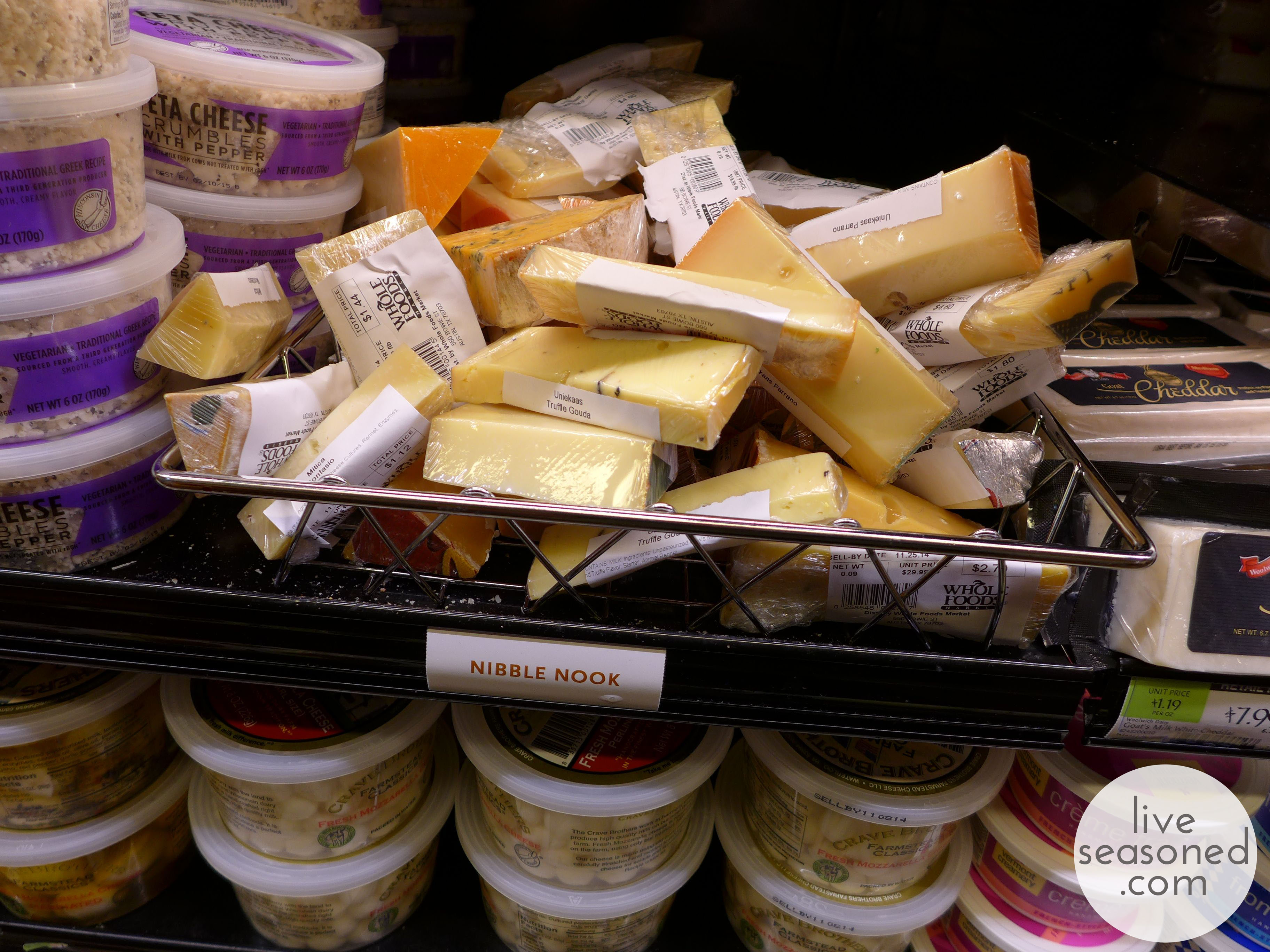
There really are so many cheeses out there, and while I’m an adventurous eater, I often find myself sticking to a handful of cheeses that I know and love. Just walking up to the cheese counter is overwhelming ~ so many varieties, where do I even start? And then I would look at some of the prices and just shyly turn around and pick up my Cabot or Brie Supreme and go on my merry way. Or, that was the scene until I discovered Whole Food’s Nibble Nook!

liveseasoned_fall2014_nibblenook1_wm

The Nibble Nook is a little basket of cheese ends/remnants (you can see it above tucked in between their off-the-shelf cheddar, feta, and mozzarella). My guess is that many grocers selling cuttings of large cheese wheels may have their version of a nibble nook. If you’re open to trying some new cheese and flexible as to the options available, the Nibble Nook is a great place to look. The selection within the basket is constantly changing as different cheeses are cut and as shoppers pick out their favorites. And the cuts are small, so while I would be hesitant to be a large wedge of a cheese that’s priced at over $20/lb, I’m happy to buy a small bit for nibbling.

liveseasoned_fall2014_nibblenook3_wm

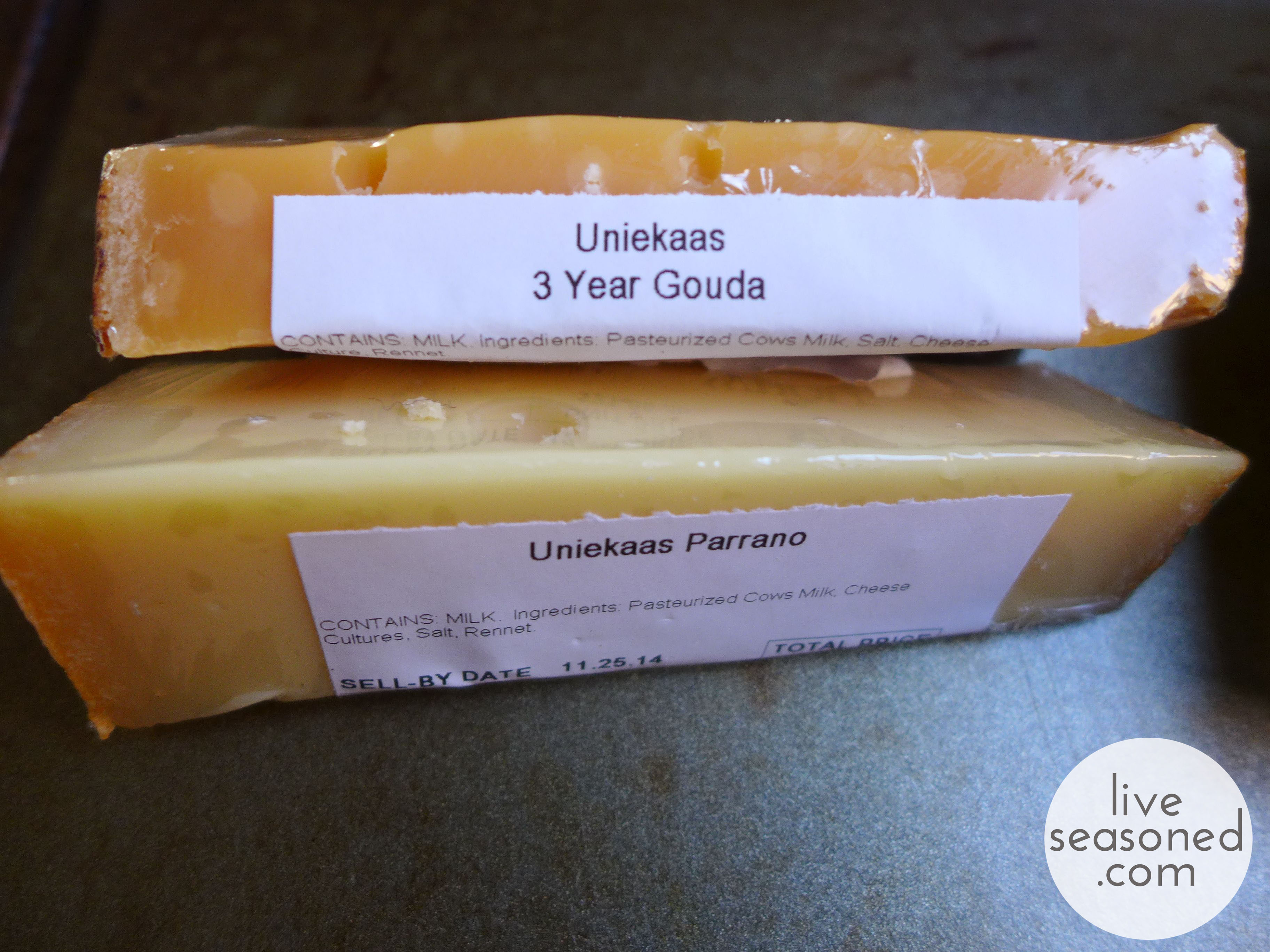
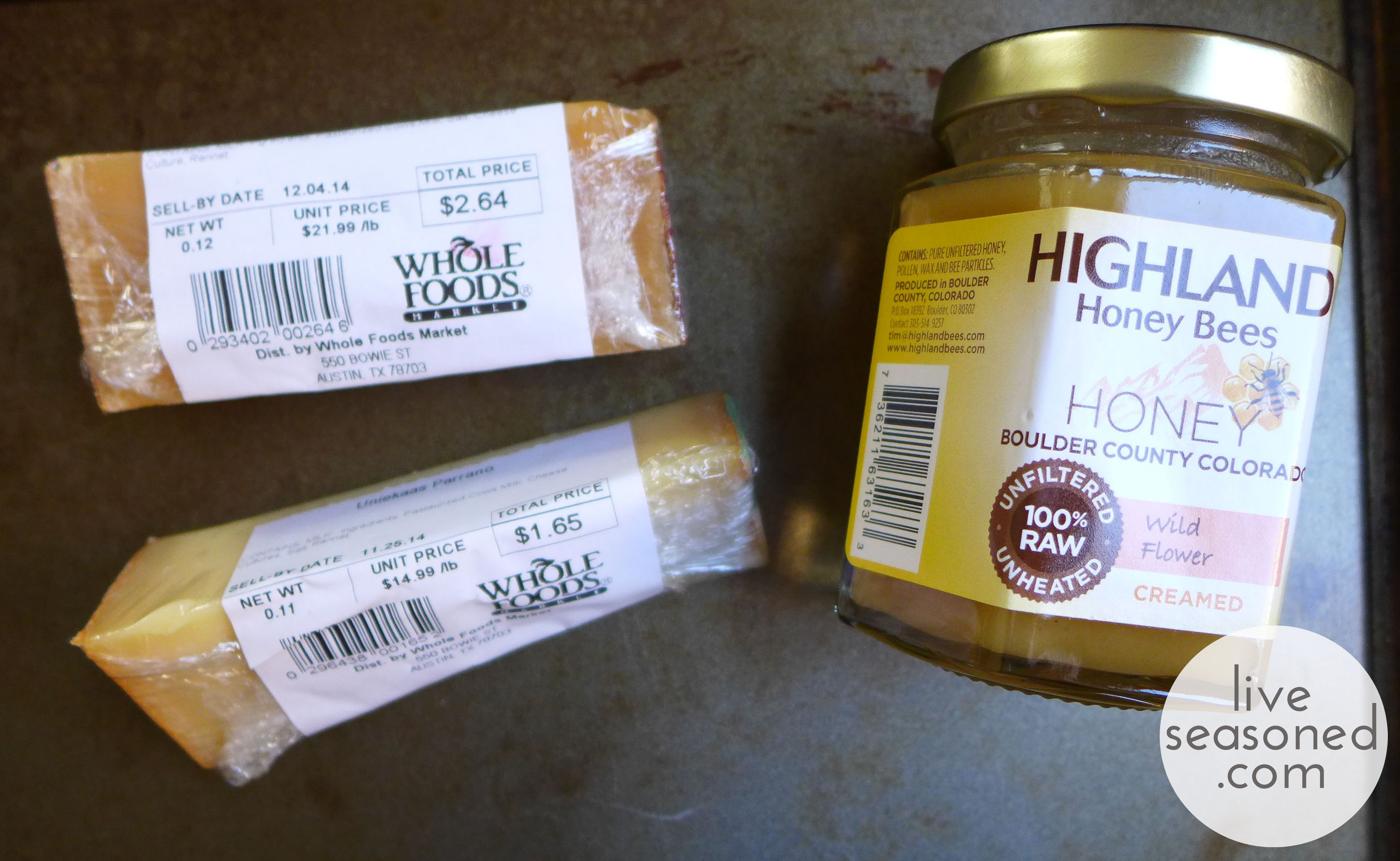
I always approach the bin with an open mind and pick out any cheeses that look promising (that’s every cheese), and right now I’m also sticking to only those made with pasteurized milk. On this particular visit, the bin was overflowing with two varieties of hard cheese from Uniekaas, a Dutch company: a 3 year Gouda and a Parrano. I’m sad to say, I had to pass on a beautiful looking cheese that had bits of black truffle throughout but was made with unpasteurized milk. From the labels, you can see that each of the cheeses I picked has a big price tag ($22 and $15 per pound), but the wedges are both close to a tenth of a pound, making it an affordable splurge (is that a thing?).

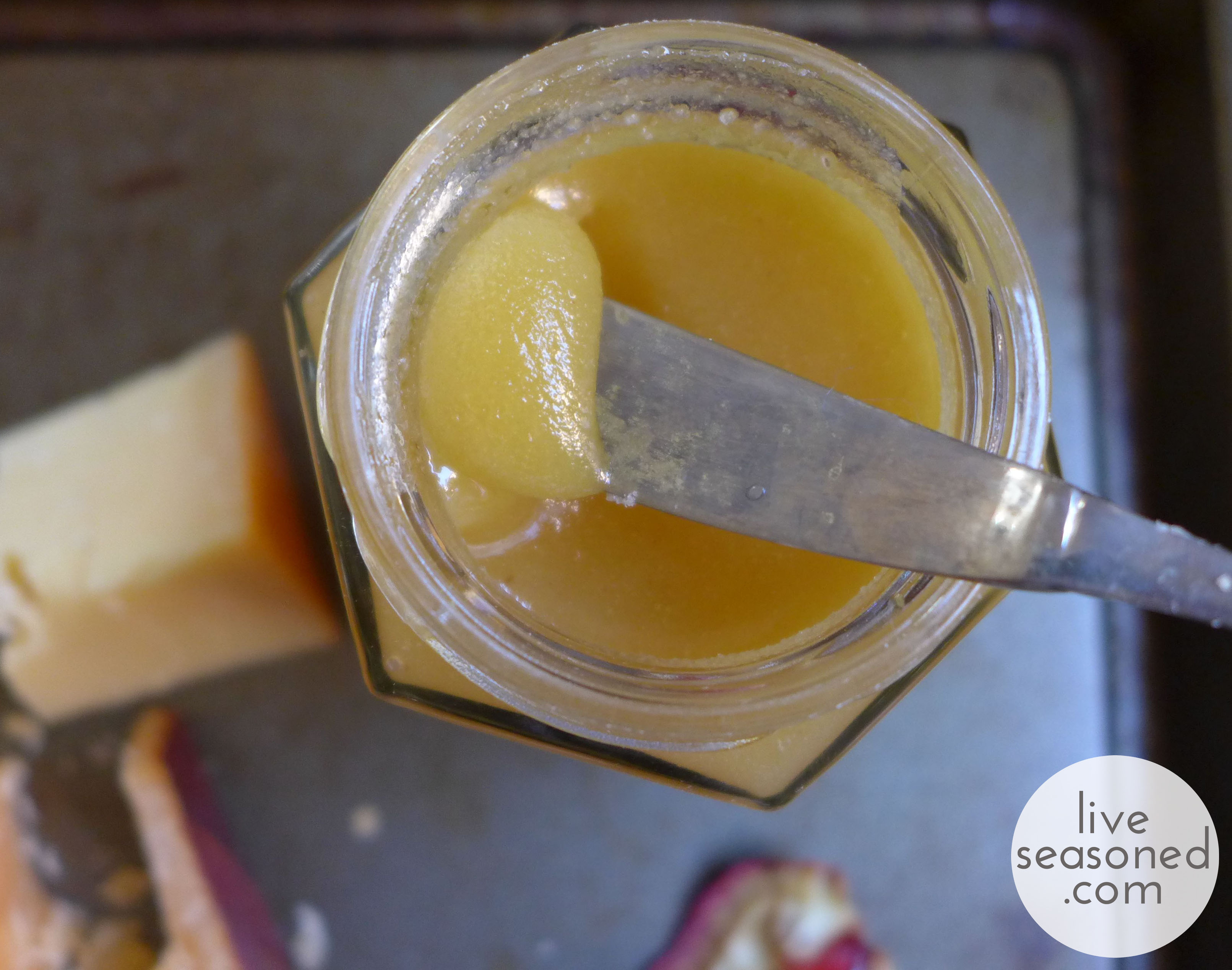
liveseasoned_fall2014_nibblenook2_wmI also love Whole Foods visits for their constant sample tables, on this particular day a table of raw uber-local honey (from hives within our county!), was perfectly positioned at the end of the cheese aisle. They even happened to be serving up the samples with a variety of Parrano, so I had to pick up a jar. And as you’ll see, it ended up making such a perfect treat!

liveseasoned_fall2014_nibblenook10_wm

A little bit about the cheeses. Both of these cheeses are considered great snacking cheeses in the Netherlands, their home country.

Gouda

(The orange cheese in these photos)

Gouda is a Dutch hard yellow cheese made from cow’s milk. The cheese may be aged anywhere from a month to many years. This particular Gouda was aged for three years, classifying it as a “very old cheese”.  As a Gouda ages it acquires a caramel sweetness and develops a slight crunch from cheese crystals that form as water within the cheese evaporates. The cheese’s sweetness is due to removing some of the whey, which also removes some of the lactic acid, early in the cheese-making process and replacing it with water.

Parrano

(The white cheese in these photos)

Parrano is also a technically a Dutch Gouda, but with a flavor similar to aged parmesan. Parranos are aged for about 5 months, giving them a semi-firm texture. As described on the company’s website, Parrano is “slightly sweet, a little bit nutty but still with a deliciously strong flavour”.

liveseasoned_fall2014_nibblenook6_wm

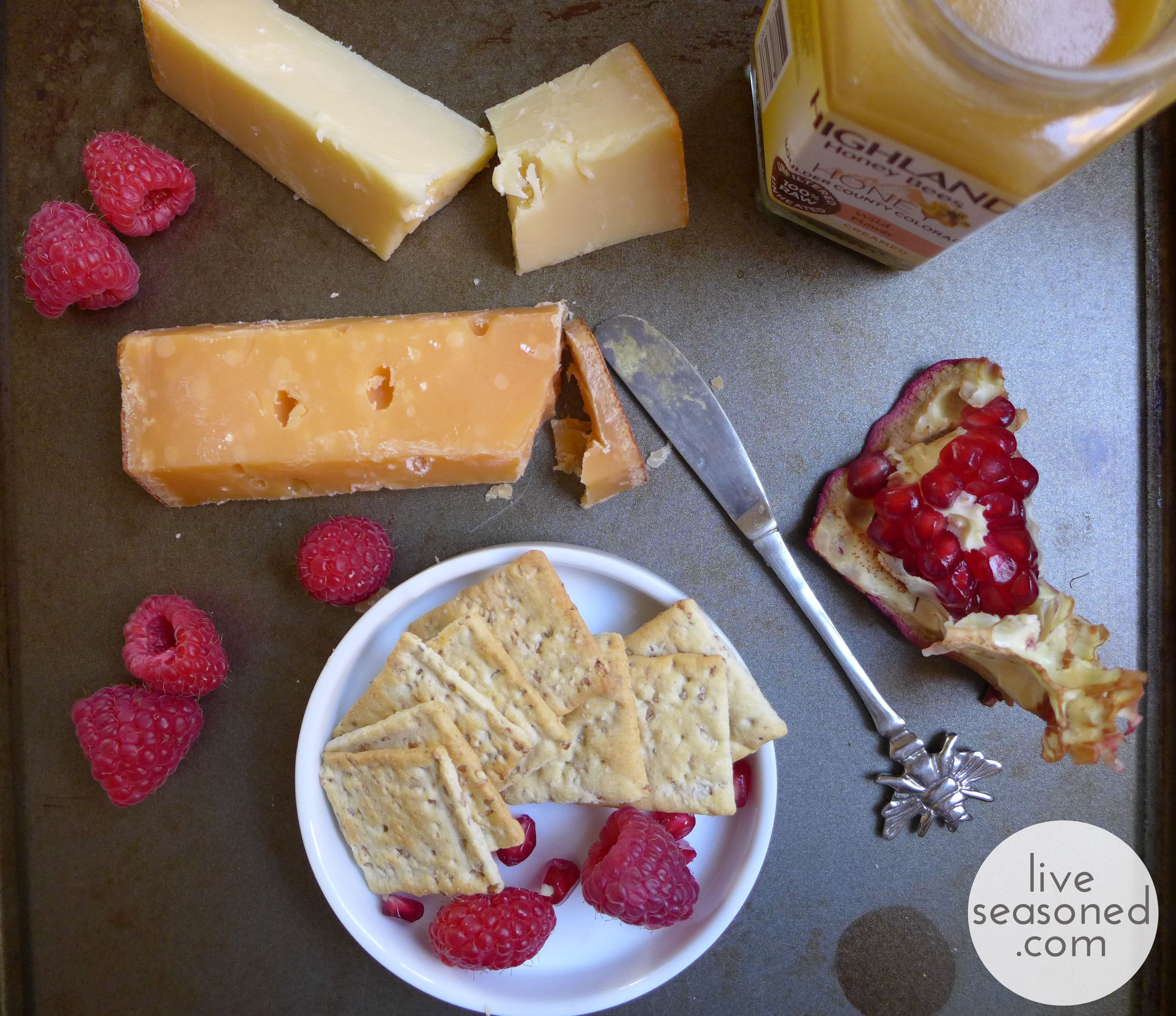
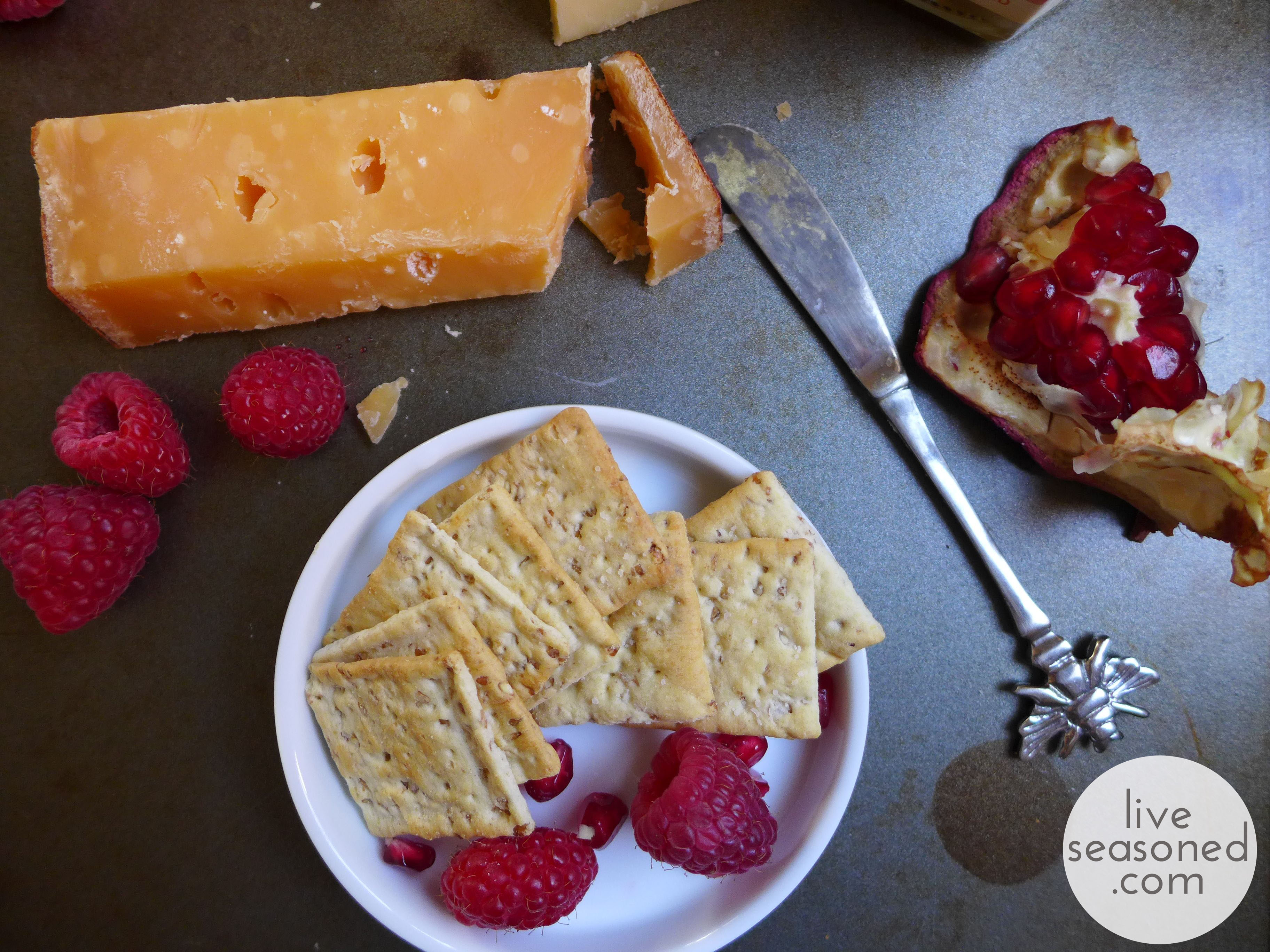
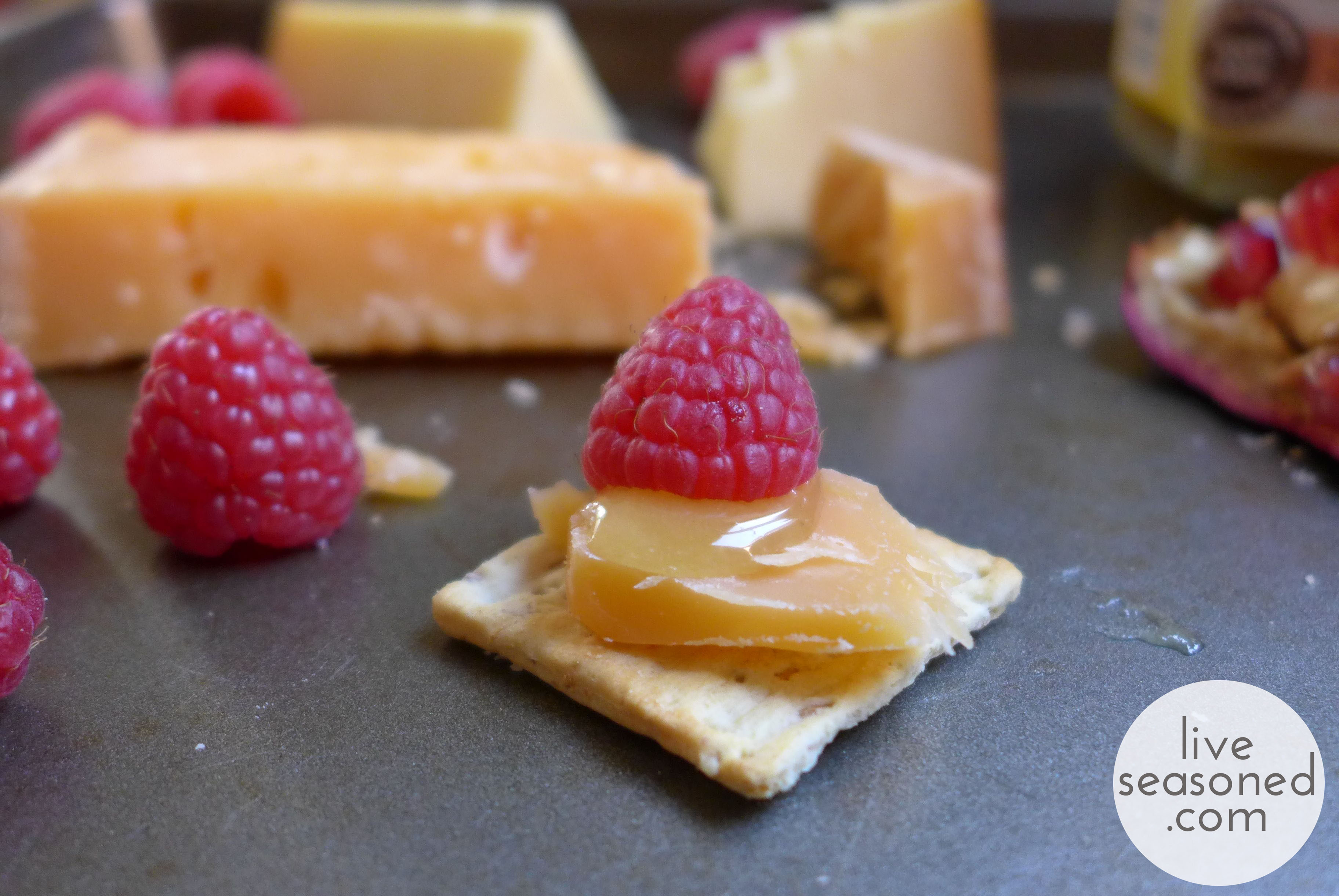
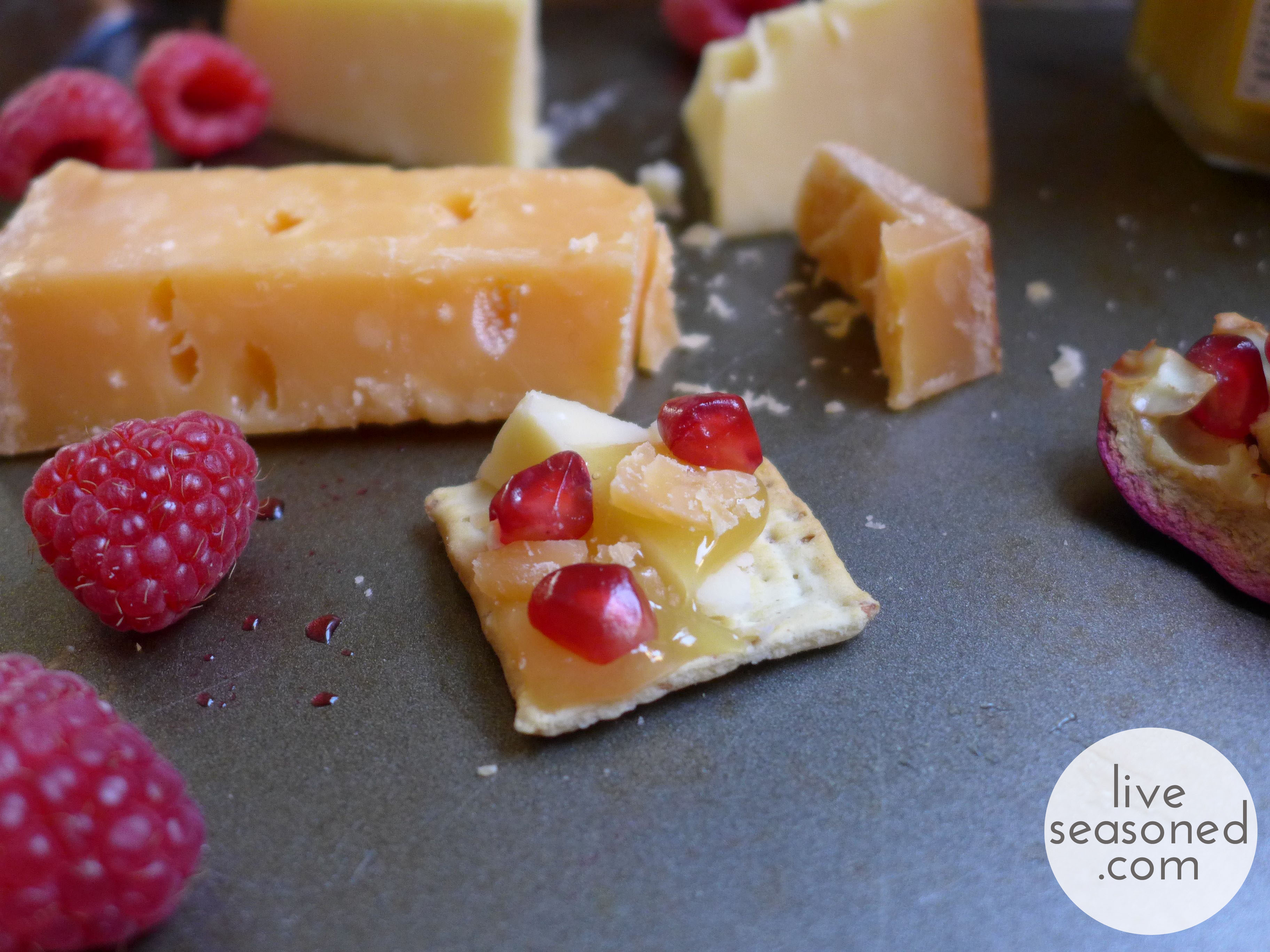
As is common, I like to include some fruit on my cheese plates. Continuing with my adventurous ways, I’m not too picky when it comes to the fruits I choose. I’ll often look for anything in season and deliciously ripe (there’s no point in serving out-of-season strawberries that taste like water, right?). On this particular day, I already had some raspberries and pomegranate in my fridge. As it turns out, their slight tartness was a perfect complement to the sweet honey and sharp cheeses!

liveseasoned_fall2014_nibblenook7_wm

 The Honey

This is a raw, unfiltered, and unheated honey. As a result, it has a cloudy appearance from the honey crystals that have begun to form (it may also have some bits of wax, pollen, bee wings, and such in the jar). If you put a dollop of raw honey on a plate, you’ll find that it spreads more slowly than crystal clear honey. It turns out that this is really useful for gluing some fun cheese/cracker/berry combos together! And here you thought raw honey was just good for its enzymes.

liveseasoned_fall2014_nibblenook9_wm

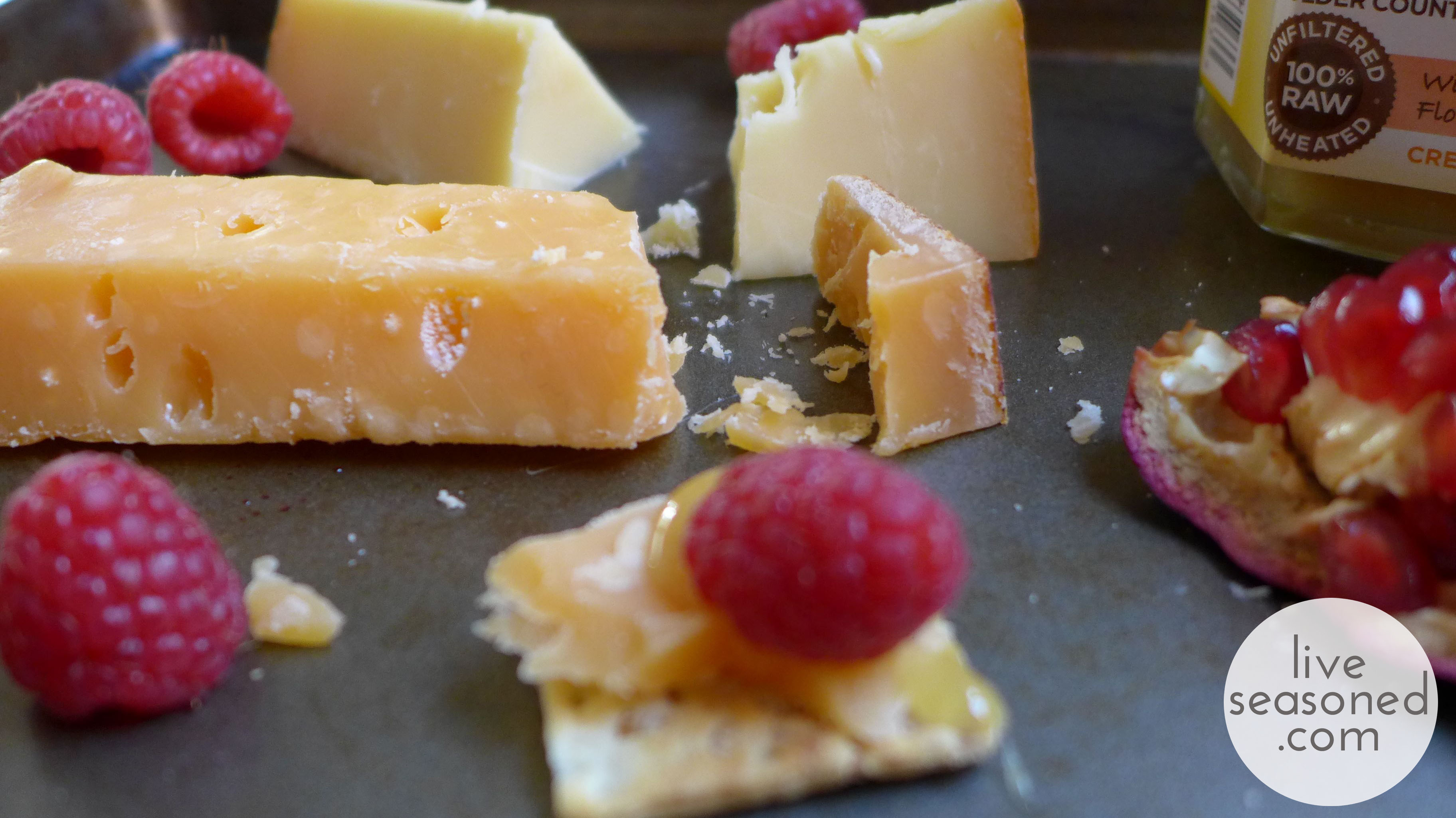
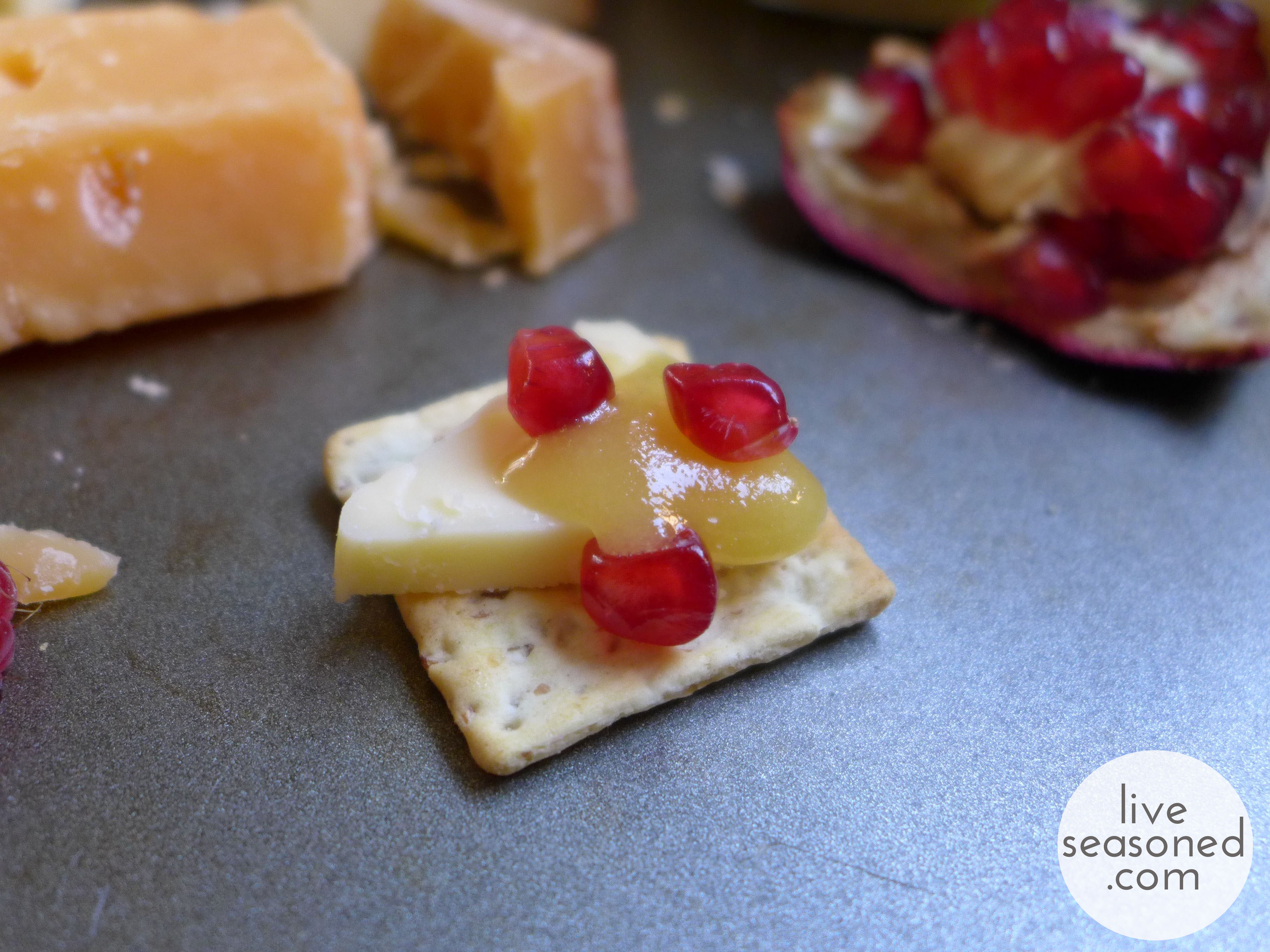
Look at how beautiful that cracker looks with a bit of cheese, dollop of honey, and a few perfectly placed pomegranate seeds! There’s no way those seeds will fall off on the way from the plate to your mouth. This is a particularly handy trick for cocktail parties if you want to make a few fancy cracker/cheese combos rather than having guests make their own. You definitely don’t have to worry about the appetizer falling apart before it’s served. I also found honey to be particularly useful for keeping the crumbly gouda on my cracker. You can see that I double-dipped in the last photo – starting with a slice of Parrano and then adding crumbles of Gouda over the honey. indulge much?

liveseasoned_fall2014_nibblenook11_wm

I can’t emphasize enough how delicious these particular combos were. The crackers were just a basic wheat thin. Both cheeses had a bit of a nutty flavor. The honey added that touch of sweetness. And then, as I already mentioned, the fruit added a bit of a tart note. Plus it was extra fun to get that little spray of juice and crunch when biting down on the pomegranate seeds.

liveseasoned_fall2014_nibblenook12_wm

And this adventure all started with a quick trip to the Nibble Nook. Who knows what next week’s visit will hold… and I can only hope that come April they add some of that truffle cheese back to the bin!

So tell us – does your grocery store have their own version of the nibble nook? Did you find any really outstanding cheeses there?


Welcome November

On the first Wednesday of each month we like to pause and take a look at what’s going on in the world around us, with a particular focus on animal activity, celestial events, and our farmers’ fields.

liveseasoned_fall2014_nov5_wm

I don’t know what happened this year, but as soon as the calendar flipped to November I had a twinge of nervousness that the season’s passing to quickly. Did you feel that way? It’s the mix of looking forward to and preparing for Christmas while at the same time trying to live in the moment and enjoy every bit of the slow days before Thanksgiving. In an effort to mix the two, I have big plans for long evenings in front of the fire slowly crafting away on holiday projects… we’ll see how that goes. It was nice to look through photos from Novembers past and realize just how much we are able to pack into this one month. From the ones I’m sharing in this post, it’s a pretty even mix of travel, time outside, and of course, the Christmas prep that I love. I hope your month is a mix of all the good things you love too.

We’ve had such a mild fall in Boulder so far, it’s hard to believe that at the end of the month we’ll be visiting Calder’s family in CA, where, if we’re lucky we’ll be knee deep in snow, risking our life sledding, and (unsuccessfully) dodging stray snowballs!

Earth & Sky

As the seasons change from summer to winter, fall is another important and busy time for migrating animals. I thought it would be fun to move from land to sea this month and look up the migration activities of animals that live in or are closely linked to an ocean.

Humpback Whales

Every year populations of humpback whales cross the Pacific from north to south as they move from their summer feeding grounds along the shores of Alaska and Russia to their winter breeding grounds off the coasts of Hawaii, Mexico, and Asian Pacific Islands.


The largest winter calving grounds are in the waters around Hawaii, and particularly off the island of Maui in the Humpback Whale Marine Sanctuary. You can expect the first whales to begin arriving in these waters by September or October, but you are guaranteed to see them starting in November. The whales will stay in the area through May, birthing their young and teaching them basic behaviors, from breaching to tail and fin slapping. If you’re lucky enough to vacation in Hawaii this winter, listen for the male humpbacks singing!

Christmas Island Red Crabs

Christmas Island, located in the Indian Ocean, is home to an endemic species of land-dwelling crabs. For most of the year, the crabs live a solitary life inland, eating leaves and flowers, but every year between October and January, the crabs migration en mass to the coast to mate and spawn. With a population of over 40 million crabs all moving at once, this migration is awe-inspiring, and can cause a bit of a headache for local travels. The crabs can take-over roadways, and often roads that cross their migration route are closed off to let the crabs pass. The start of the migration coincides with the wet season on the Island. Generally, the crabs have to be very conservative with their movements in order to conserve body moisture, but with the rains, they are able to move more freely and make the migration to the coast.

Once at the beach, the male crabs will create a burrow where they will mate with the female crabs. After mating, the males will return to the forest while the females will stay in the burrows for up to two weeks as the eggs develop. The females will then deposit their eggs in the ocean where the larva will hatch and spend 3-4 weeks before returning to land as young crabs. What’s really interesting about the whole event is that the female crabs deposit their eggs in the ocean precisely at the turn of high tide during the last quarter of the moon!

Understanding the timing of that activity, the possible spawning dates for this year are October 19th, November 18th, or December 18th. It all depends upon when the rains begin to fall.
Fields & Festivals

I think of November and I think about good, hearty, home-cooked meals. What about you? Our farm share continues to deliver into December, so I’ve started researching some new-to-me savory veggie recipes for the season. On Monday I made my own version of this savory galette using fresh kale, leeks, and butternut squash. Tonight it’s a spinach and salmon quiche, and tomorrow it’s short ribs with a side of roasted acorn squash.
liveseasoned_fall2014_welcomenov1_wm

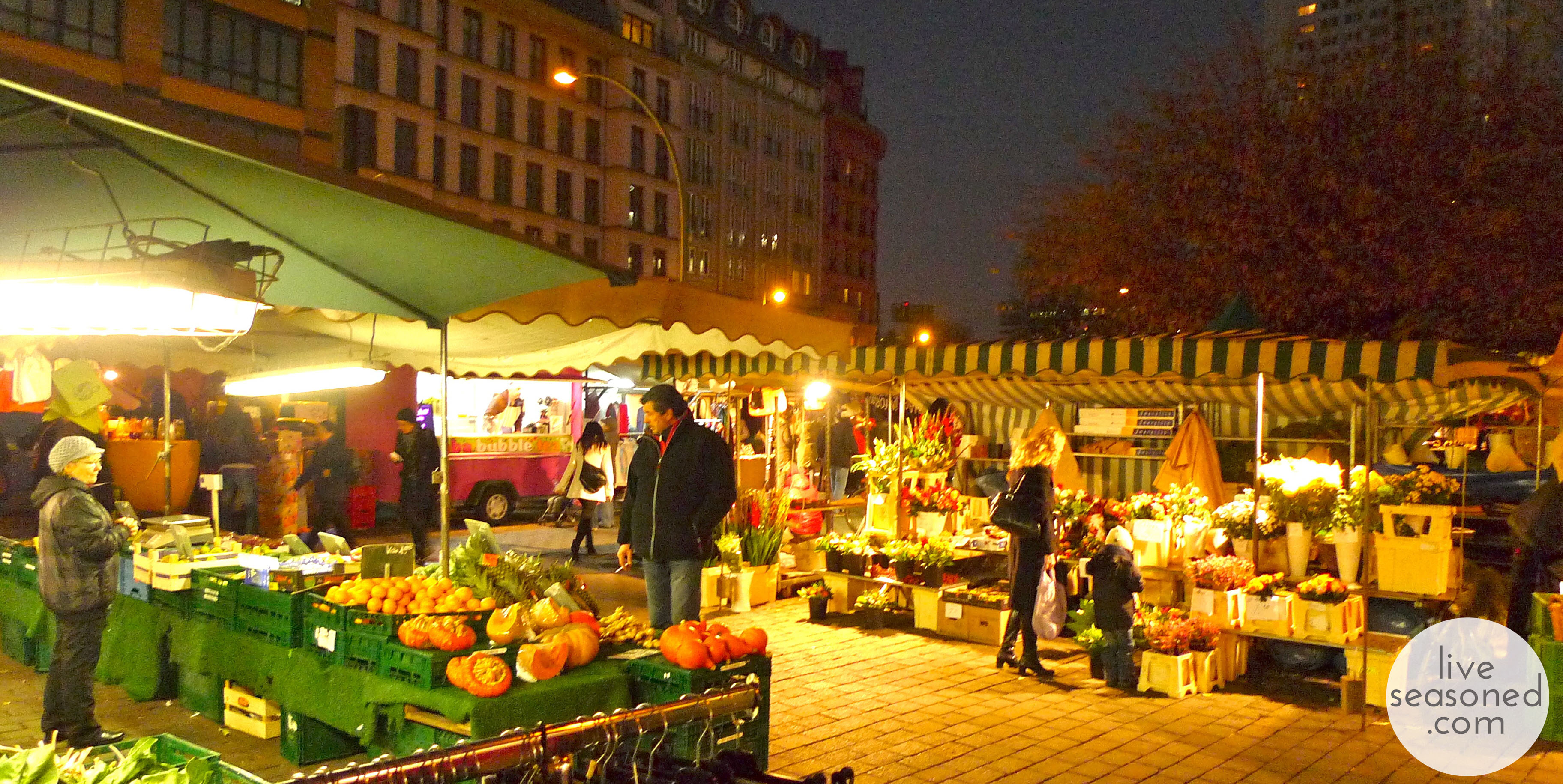
There are still plenty of veggies coming out of the farmers’ fields, and plenty going into storage for the winter, so don’t reduce yourself to iceberg lettuce and applies shipped from New Zealand yet! If you’re lucky, your local farmer’s market may still be in operation. Don’t wait to get out there and pick up something fresh. I took the photo above at an evening market in Berlin as I passed through a couple years ago for work.

liveseasoned_fall2014_nov7_wm

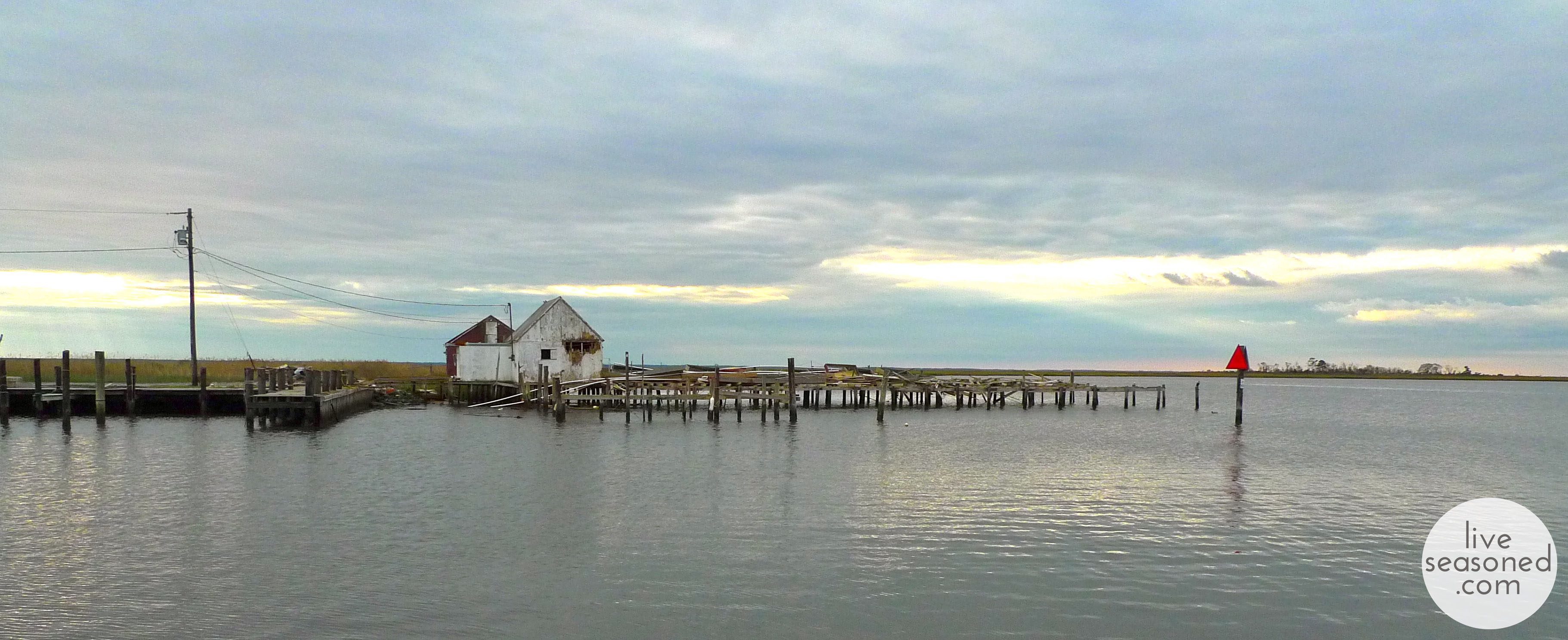
When it comes to festivals, there are still some great food-focused events going on. Sarah’s heading to Saxis (photo above taken as the sun rose over the town’s marina two Novembers ago) to hit up the Saxis Oyster festival this weekend! If you’re looking for something fun to do this weekend, you may find the calendar dominated by craft fairs and festivals – we think they’re a great way to support independent artists and pick up unique gifts for holiday giving. Below are a few we would love to check out. If there’s anything fun going on in your area, let us know!

liveseasoned_fall2014_nov6_wm


As I’m signing off, I’m thinking about ways to wrangle this baby-turned-toddler for some Christmas card photos!

Whale map from KQED. Whale image from Animalians wikispace. Red Crab image from here.

Two Bits

Each Friday we share some tidbits from our week.  We want to break down these internet barriers and invite you into our lives and we’re hoping you’ll do the same.  You are welcome to share a bit of your week or day in the comments, or if they’re better represented by a photo, tag us on instagram @liveseasoned

Sarah Here:

liveseasoned_fall14_twobits-1

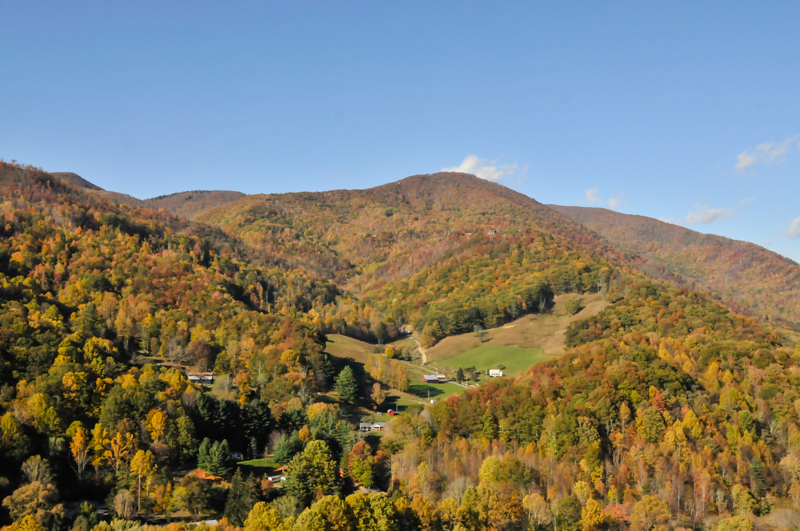
I had a fantastic fall week!  I took a road trip to Asheville, NC and I camped creekside for a couple days.  The weather was actually a bit cooler than I anticipated, but it was nice warming up near the campfire each night.  Kevin, Cash the dog, and I spent our days winding along the Blue Ridge Parkway and visiting tiny towns and hiking trails in the Blue Mountains.  We spent our evenings eating out in Asheville, which was a welcome treat for the both of us.  If you’re headed to Asheville anytime soon, head to Over Easy Cafe for breakfast and Farm Burger for lunch or dinner.  Also, hit up Wicked Weed or one of the other dozen breweries for a buzz.  We wished we had more time to explore, but the little bit that we saw we enjoyed so much.  I had about a dozen more shops and restaurants on my to-visit list so I know I’ll be back.  I’m actually thinking that Asheville is the next stop on my home tour and Farm Burger is definitely helping the case as far as Kevin is concerned!

My other bit is the satisfaction of packing up a whole lotta bits.. I’m packed up and ready to move out! At noon today I’m going to pick up at 16 foot box truck, just imagine that while you’re on your lunch break 😉 I’m moving into an apartment with high ceilings and a big backyard. It’s actually smaller than the place I’m renting now, but the outdoor space makes up for it. I can’t wait to film my inaugural house tour! Hope your Friday is a bit more relaxing than mine, but just as exciting 🙂

Colorado Hike: Flatirons 1 & 2

liveseasoned_fall14_flatironshike-1

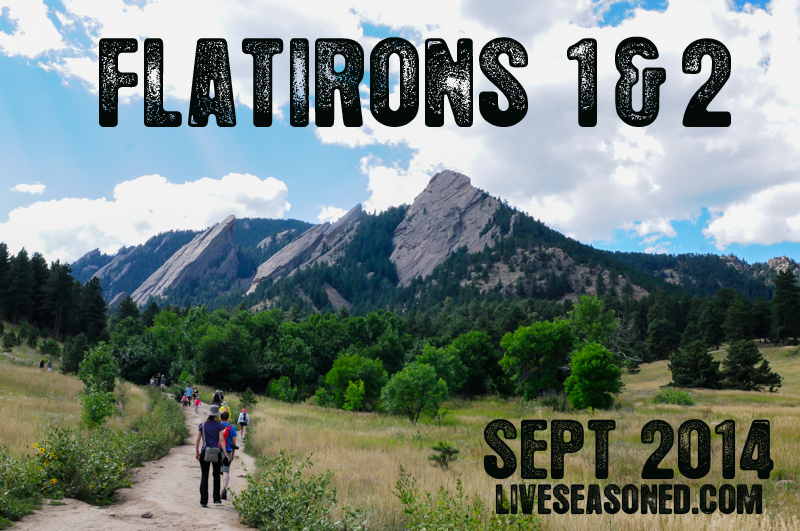
About a month ago, Katie, Jeff (our brother) and I hiked the Flatirons 1 & 2 trail.  I’ve been meaning to write this post for some time since it was one of the most scenic hikes in Boulder, CO, so here goes:

liveseasoned_fall14_flatironshike-1-2

The hike starts at the Chautauqua Park trailhead.  Parking in the lot can be pretty tricky, especially on the weekends, but you can find additional parking on Baseline Road.  That being said, the trail is extremely crowded.  You won’t have the views to yourself, but hey, at least there is no chance of getting lost. After you find a parking spot, continue to the Chautauqua Park trailhead where the trail takes you through a lovely green meadow.  (Note that if you’re hiking right after a rainstorm, it will be pretty muddy since the trail is basically a path for runoff water. ) The Chautauqua trail connects with the Flatirons 1&2 trail and the signage is very clear as is the flow of people flocking to the Flatirons 😉

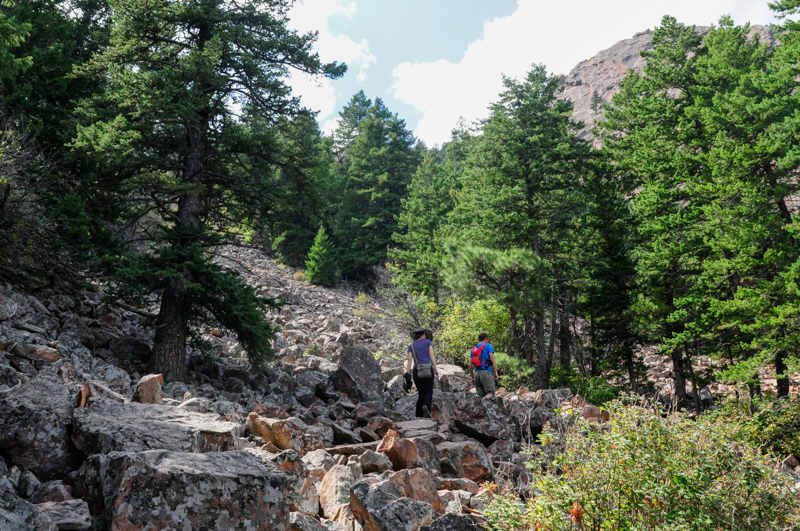
Over the course of this relatively short hike (about 2.5 miles), you will climb 1,400 feet in elevation.  Flatiron 1 is approximately 7,100 ft high, which makes for stunning views.  As you hike up the trail, there are plenty of outcroppings that are perfect for taking a break and enjoying the vistas.  The Flatiron trail is mainly switchbacks through thick forests of ponderosa pine that cut around enormous boulders.  Along the way, there are also several rock climbing access points.  Speaking of climbing, there is a very short section of the trail (about 15 feet) where you have to climb up a boulder.  There are footholds and handholds worn into the rock making it easy for adults, but I wouldn’t recommend taking children on this hike.  I would also turn back immediately if it starts to rain because the rocks will become slippery making a large portion of this trail fairly dangerous.

Once you finally wind up, up and up, the views are spectacular.  There are clear views of the city of Boulder as well as amazing views of Flatiron 3, which is sure to have rock climbers scrambling up it.  The top of the trail is a perfect spot to stop and have a snack or a picnic, but remember to hike all your waste out with you, even banana peels!  The top of the trail is like an adult jungle gym.  You’ll see folks in all different nooks and crannies.  It goes without saying that you should be careful when you’re climbing from boulder to boulder, don’t knock into any rocks that may fall and injure someone at a lower elevation.  After you’ve climbed your heart out and took a bajillion pictures, it’s time to make your way down the ridge.  Be mindful of other hikers who are still making their way up and if they look like they need encouraging remind them that they’re almost there!

Geology Rocks! I say that far too often, but I just can’t resist.  Here’s a quick rundown of some geological properties of the flatirons.  I’m going to give some definitions in case you slept through your geology lab class.

  • A flat iron is a steeply sloping triangular landform created by the differential erosion of a steeply dipping, erosion resistant layer of rock overlying softer strata. Differential erosion is erosion that occurs at varying rates, caused by the differences in the hardness and resistance of surface materials so softer and weaker rocks erode rapidly, while harder rocks remain to form ridges, mountains, or ding, ding, ding, flat irons!  Strata is simply sedimentary rock. Sedimentary rocks are those formed by the deposition of material either on the earth’s surface or in water.   And wouldn’t you know it, the Flatirons of Boulder coined this term, flatiron, in general geology.
  • Now you may be wondering how the Flatirons first got their name, which then coined the geography term. Well, there are two theories: the rock faces close resemblance to old fashioned clothing irons or their resemblance to the Flatiron building in NYC, which was completed in 1902. (It’s a pretty sweet building, but personally, I think it’s more likely they were named after the clothes iron, an object which many more folks were familiar with during the early 1900s)
  • The flatirons are made up of conglomerate sandstone of the Fountain Formation. Conglomerate sandstone basically means there are little clasts (bits of rock particles) mixed into the sandstone (rock comprised mainly of sand-sized minerals or rock grains). I don’t want to wind way down into a geological rabbit hole (for your benefit), but the Fountain Formation is a Pennsylvanian (the subsystem, not the state) bedrock unit found in Colorado and Utah that consists mostly of conglomerate sandstone or arkose.
  • The flatirons are estimated to be 290-296 million years old and they were tilted to their current orientation (the steep dip I referenced earlier) about 35-80 million years ago during the Laramide orogeny. The Laramide orogeny was a period of mountain building in western North America, which created the Rocky Mountains along with many other formations. I won’t go into right now, but it’s definitely interesting; if you like geology and want to learn more, read this.

What to expect:

  • Lots of hikers on the weekend.
  • Dogs both on and off leash.
  • Plenty of wildflowers, various vegetation and trees and beautiful views.
  • Two hours (or more) of hiking.
  • A couple tough climbs over boulders, but mainly a moderately steep and well-maintained trail.


Before of after your hike, be sure to stop by the historic ranger cottage near the parking lot – you can’t miss it.  It has a wealth of information, free maps and dozens of stuffed birds and mammals.  I really enjoyed the station because I gained a better sense of what animals were sharing the forest with me.  It’s especially cool to see the animals you have very little chance of seeing in the wild like mountain lions, coyotes, and bobcats.  If you want a little snack, continue past the ranger station for about a block and you’ll see a little refreshment cottage with homemade hard ice cream and just about everything else.

liveseasoned_fall14_flatironshike-3-5

After the hike and the ice cream, you should probably treat yourself to an afternoon snooze! Happy hiking!

Kombucha Kraze

liveseasoned_fall14_kombucha-6

If you follow our Instagram, you know that I spent the past two weeks in Boulder, Colorado with Katie.  I had a great time catching up with my nephew, baby A, and the rest of the Colorado crew.  We had such a great time that we may have slacked off on the Seasoned front last week, notice that?  Unfortunately, I’m home now, but the good news is I have plenty of time to blog and lots of material from CO to share with you all.

There is no way that I could pick a favorite activity or day from my Boulder vacation, but the kombucha tasting room was definitely the most unique outting.  I had never been to a kombucha taproom and to be honest, for the longest time, I thought I disliked the brew altogether.  Never heard of it?  I think this post is a helpful introduction. I usually describe it as a fermented tea, but that usually always turns people altogether off immediately.  I have to admit, initially I was turned off too.  

Back in the day, Katie used to share sips of her State College farmers market kombucha and after the first few tries I would politely decline. “Thanks, but no thanks.”  It wasn’t until this past Summer that I really enjoyed a glass of kombucha.  I took a trip to the Honeysuckle Tea House and tried a glass of the Fire kombucha, which is a blend of ginger and spices.  I was pleasantly surprised at how much I liked it. It was simply an earthy, carbonated drink and it was healthy to boot!  Just like that, I was a convert.  I was ready and willing to taste test away, so off we went to the Rowdy Mermaid Kombucha Taproom in Boulder.

liveseasoned_fall14_kombucha-11

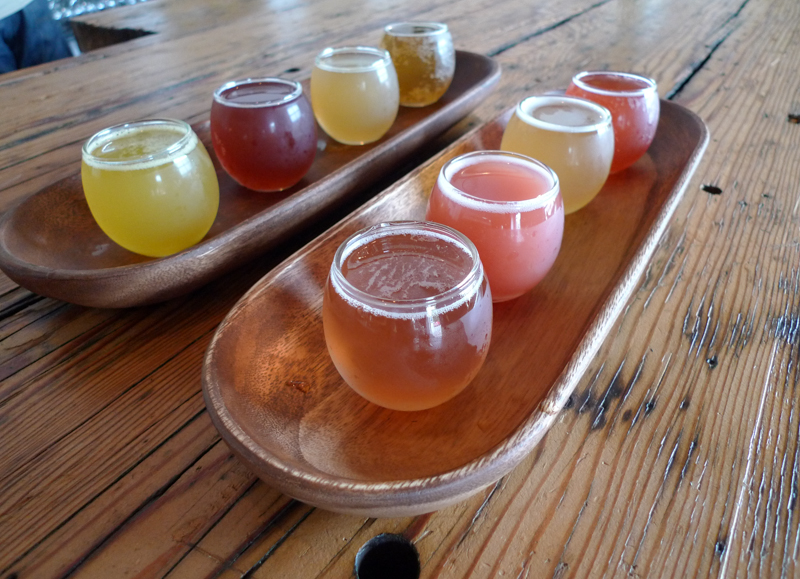
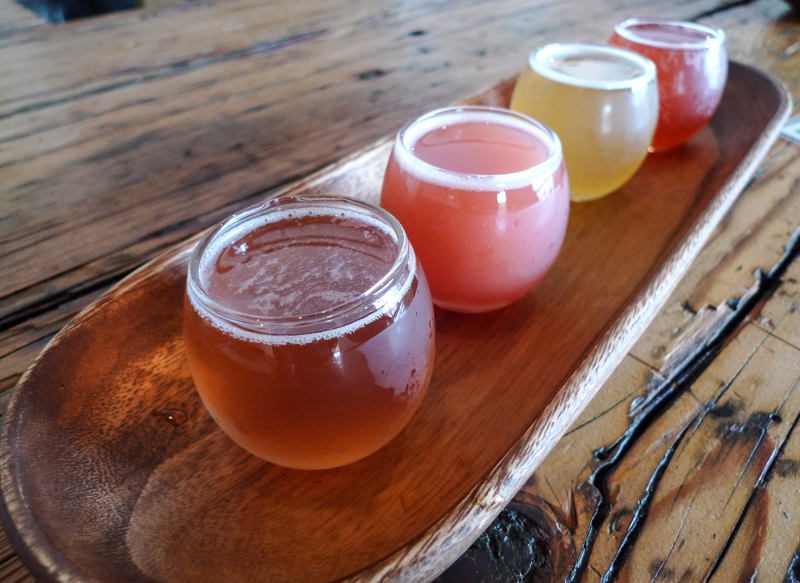
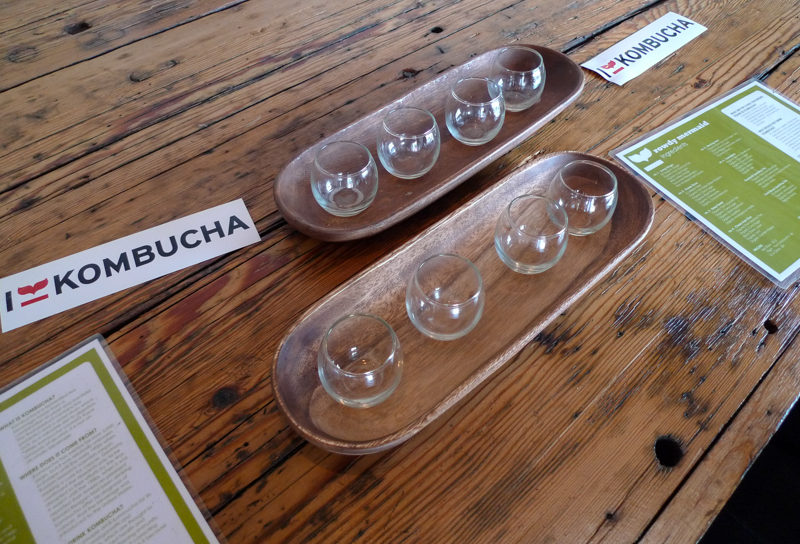
We decided to order two flights  of 4 glasses each.  Flights are only $6 and there were exactly 8 drinks on tap, so how could we not?  When Davidleo, our server and kombucha brewer, placed our flights on the counter I was blown away.  The colors were vibrant and beautiful.  Each glass had its own distinct aroma and flavor and I can say, without a doubt, that I enjoyed every single one.  This is huge for me.  I went from shying away from ALL kombuchas to sipping down eight different flavors.  I felt a little bit giddy. I had discovered a new career, kombucha taste tester. Ok, you’re right, I’ll slow down and keep my day job, but I was really pumped about this new self-discovery. I’m a kombucha lover! I might even stick the kombucha bumper sticker on my subaru.. it’s that serious.

liveseasoned_fall14_kombucha-2

After taking a handful of tiny sips from each glass, Kate and I both decided on our favorites.  I couldn’t get enough of the Pineapple Tumeric, while Kate was all about the Deep Forest.  Some were definitely more earthy and effervescent than others, which is why we decided on a fruity and sweet variety to take home to the family.  We figured they would be more inclined to try our strange fermented tea if we called it something like ‘strawberry fizz’ instead of Morning Dew or Flower Grow.  While we were successful in having our mom, bro and Calder try the strawberry kombucha, they definitely didn’t dig it.  I think they need to suck it up and visit the taproom, try all eight and then tell me what they think, but for some reason that plan went in one ear and out the other…

Katie here: It’s so great to hear Sarah’s experience with kombucha and her slow change of heart! I’m partial to fizzy, not too sweet, slightly odd tasting drinks, so I loved kombucha from my first sip. That said, I’m not too adventurous, and when I’m paying $2/bottle and sometimes more; I often stick to the basic flavor that I know I love (for me it usually involves a touch of ginger). That’s why, even as a devotee, going to the tasting room was a great experience for me – opening my palate to the amazingly wide variety of flavors that I could have been enjoying all of these years! I also love what you can learn when you go to a tasting and talk to the brewer. I had assumed that all kombuchas would have caffeine because they are usually made from green or black teas, but they don’t have to be! This shop offered a couple of caffeine free varieties, using herbal teas as their base. 

Hanging out at the kombucha bar and getting a buzz fizz on was surely a highlight of my Colorado vaca.  I’ve been thirsty for some fermented tea ever since so I’ve been researching other kombucha taprooms.  I wish I’d done this yesterday when I was in Charlotte, I could have hit up Lenny Boy Breweing Co