I’m sure a lot, if not all of you, already meditate in some form or another. Maybe you clear your mind while you exercise or while doing the dishes or while taking a shower. When you are alone with your thoughts you’re beginning to meditate. Over the past couple of years, I have read a few powerful books about mediation and self-discovery and I believe they have had a big impact on my overall happiness and upbeat attitude. I’ve learned to direct and guide my thoughts in a constructive way instead of arguing with myself. Self-love is always in season so from time to time we’ll be sharing a little bit about our paths to self-discovery and tips for your own, in a series called Grey Matters.
First let me start off by saying I don’t identify myself as a Buddhist per say and I’m not here to promote any one religion. I do however think that the Buddhist religion has some really great insights into how to become a better individual and how to pass on that goodness to those around us. Shunryu Suzuki Roshi, founder of San Francisco Zen Center, said it best, “The purpose of studying Buddhism is not to study Buddhism, but to study ourselves.” Buddhism informs us that we should identify the intention behind our actions and whether those actions will have a positive or negative effect on those around us. If you identify with a particular religion or not, I think the Grey Matters series will be helpful to you as you walk on your path to self-discovery.


In this first installment of Grey Matters I thought it could be helpful to give a little primer on meditation and setting an intention for your day or week. When you let your mind rest you are beginning to practice meditation. You don’t have to venture to a secluded spot and sit in the same position for days on end without talking to a soul. This isn’t your monk’s meditation. It’s a tool for self-reflection that we can all utilize. Mediation has tremendous power in that it helps us identify the motives of our actions and reactions. It helps us to expand our minds and hearts and allows both to more easily accommodate the obstacles we all face from day to day. If the word meditation makes your eyes roll then think of it as constructive thinking. Sometimes life feels like you’re climbing Mt. Everest with no coat when it should feel like you’re strolling along a beautiful beach. Taking the time to reflect while setting an intention and motivation for your day can help you transform that mountain into a plain. Meditation is a helpful tool in reducing stress, anxiety, depression, insomnia and many other uncomfortable conditions of the human mind. At first the goal of meditation is to have an open and clear mind. You can’t solve all of your problems during the first week of meditation. It’s a process so start small.
Here are a few tips to practicing meditation:
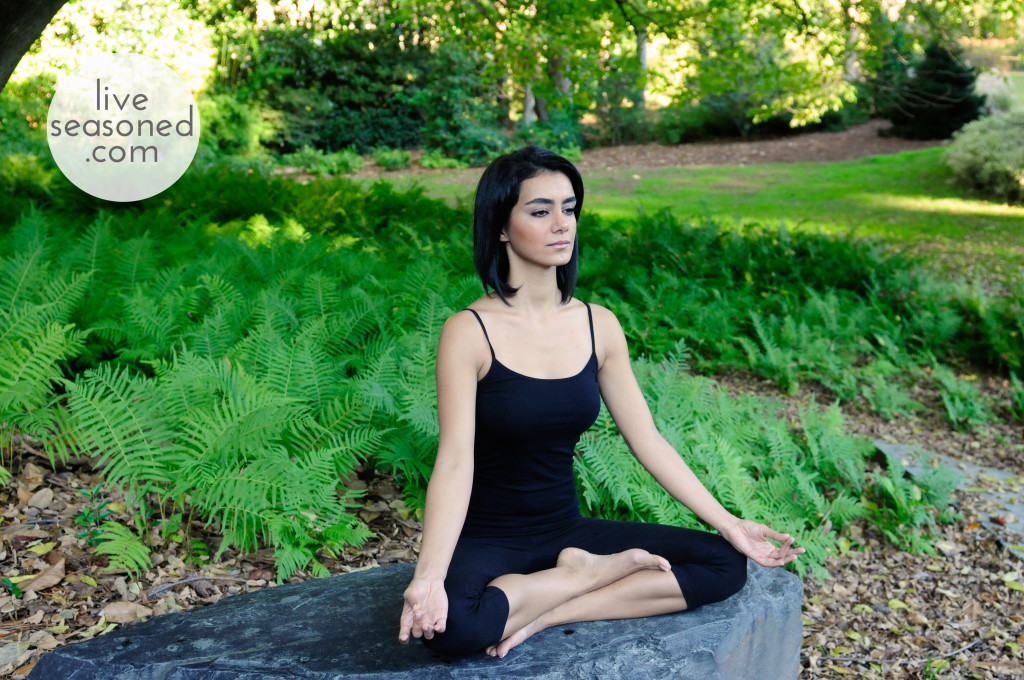
- Choose a consistent, comfortable, clean and quiet space in your home. I put a pillow on the floor in my bedroom; it’s as simple as that. Some people have a space set aside specifically for thought. Maybe it involves a comfortable cushion and a couple scented candles in front of a sunny window or maybe you’re not sold on the idea of meditation and you choose to sit at your dining room table with a cup of coffee. However you choose to begin is fine.
- Minimize distractions and focus within. If you’re sitting on the ground, sit up straight in a comfortable position and rest your hands on your knees or thighs. If you’re sitting on a chair make sure both feet are touching the ground. When you breathe in you should feel uplifted and when you exhale you should feel balanced and grounded, it’s easier to feel grounded when you’re making contact with the earth.
- Close your eyes or soften your gaze and focus on your breath. You don’t have to alter your breath, it shouldn’t be a distraction to you, but rather an anchor to the present. We are practicing being present and not letting our thoughts carry us to the past or future. Change is possibly the only constant in our lives; let your flowing breath be a gentle reminder of that.
- If thoughts pop into your mind simply exhale them away. Continue to focus on the sensation of your breath traveling in and out. Try not to get caught up in thoughts of your to do list or the fight you had with your friend. Don’t beat yourself up about all these random thoughts either, simply acknowledge that you’re thinking and then exhale the thought and return your focus to the breath.
- After five minutes feel free to leave the cushion. It’s important to keep your meditation short and regular. If you find yourself successfully freeing your mind of thought and meditating every day for five or ten minutes then you’re ready to address various issues through meditation.
After all, meditation breeds mindfulness, which is simply paying attention to what’s going on around you and not getting hooked by strong emotion. If we’re being mindful we can begin to identify our intentions and begin to work with them. We’ll save problem solving and addressing emotions for the next Grey Matters installment, but let’s start setting short-term intentions for our days and weeks.
Your intention is a thought or motivation for how you’d like to live your life. It’s kind of like a New Year’s resolution without all the pressure. You can shape your intention daily, weekly, monthly and even yearly. We’ll talk about setting long-term intentions in the next Buddha Brain post, but let’s stick to daily intentions right now.
Tips for setting a daily intention:
- Think of a positive word, feeling or focus that will guide you through the day or week. It can be a goal like writing and photographing x number of blog posts, completing a project at work or a gentle reminder like taking a nap when one is needed. It can also be an overarching, nonspecific theme like practice patience or be generous or persevere. Think about what you’re lacking, what you’d like to work on or what your body and mind really needs and create your intention.
- Repeat your intention. After meditating for five to ten minutes, repeat your intention, aloud or internally, three times with passion and motivation to carry through with your intent.
- Take your intention with you. Now it’s time to go out into the world always knowing that you have your own special guidelines by which you’ll live your life. You can repeat your intention whenever you’re feeling like your day is going off track. Know that above all else something is guiding you even when you feel lost.
If your intention was to get enough rest than you’ll feel better about working harder when you’re awake and sleeping sounder during naps or at night. You won’t have to feel guilty if you need nine hours of sleep instead of eight because you’re paying attention to what you really need to live a happy and fulfilling life. If your intention is to be more patient, it will be helpful to repeat the word patience when a coworker is talking out of turn during a meeting, when your kids are misbehaving or when the line at the grocery store is a mile long. Setting intentions is another small way to take control over emotion and immediate behavior. It’s a tool for shaping our actions, reactions and even the way we talk to ourselves. It’s a reminder that you live by your own rules. It’s time to stop feeling guilty, upset or uneasy about the choices you make. It’s time to stop judging yourself so harshly and instead knowing there was a reason for why you did whatever you did. You intended it to be so and that’s all the reason you need.
I really hope you enjoyed this Grey Matters post and learning a bit about meditation and setting intentions. I always felt like I had it all together, but once I started to peel away my emotions through meditation I realized I had a lot to learn about myself. I’m able to communicate my thoughts so much clearer than in the past and I feel like I actually know why I’m experiencing strong emotion instead of just getting wrapped up in it. I feel free from my own self-doubt and it’s really refreshing. If you’ve ever felt the effects of guilt, anxiety or doubt I encourage you to try some of the tactics in this post. I think you’ll feel a bit if not a whole ton.
Now go live lives of purpose! Whether your purpose is to take a walk in the woods, cook a delicious meal, rekindle a friendship or get a promotion at work. It is all just as important and integral in living a happy and fulfilled life.